

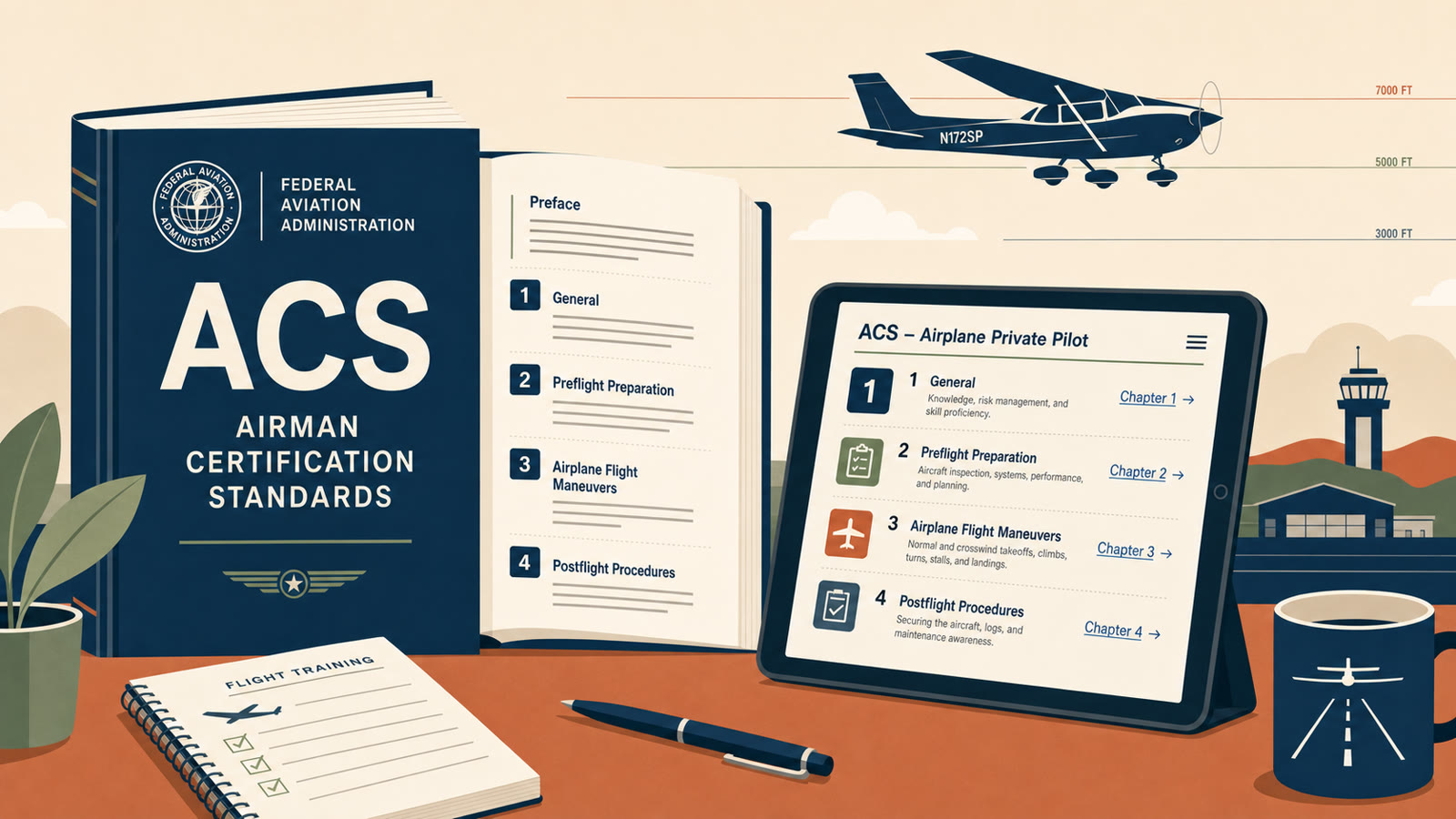
The Airman Certification Standards is the single most important document in private pilot training. It is the rulebook the FAA hands the Designated Pilot Examiner on checkride day. Every question in the oral, every maneuver on the flight test, and every tolerance the examiner grades against comes from this document. Students who treat the ACS as a checkride-week study aid tend to struggle. Students who use it as a training syllabus from day one tend not to.
This post explains what the ACS is, what changed in the current edition, how the codes work, how it integrates with the FAR/AIM and the FAA handbook series, and which third-party study tools are worth looking at. It also covers how personal minimums fit into the standards and where they show up on the checkride.
What the ACS Is (and What Replaced the PTS)
The current standards document for the Private Pilot Airplane certificate is FAA-S-ACS-6C, Private Pilot for Airplane Category Airman Certification Standards. It was published April 2024 and became effective May 31, 2024, superseding FAA-S-ACS-6B. The FAA maintains the definitive list of current standards on the Airman Certification Standards page. Always confirm the version code and effective date before a stage check or checkride.
The ACS replaced the older Practical Test Standards (PTS) format across most pilot certificates and ratings. The PTS covered only what applicants had to do on the flight test. The ACS integrates three parallel standards for every task:
- Knowledge: what the applicant must know
- Risk Management: what hazards the applicant must be able to identify and mitigate
- Skills: what the applicant must be able to do
That three-part structure is the reason the ACS matters so much more than a PTS ever did. The old test standard asked whether a student could execute a maneuver to a tolerance. The current standard asks whether the student understands the maneuver, can identify what will kill them while doing it, and can then execute it to a tolerance. Examiners test all three columns.
A significant regulatory change accompanied the release of the 6C edition. The final rule effective May 31, 2024 made the ACS a regulatory document rather than an advisory one. That means the standards it contains carry the force of regulation, not just guidance. Applicants and instructors should treat every line item as mandatory.
The Companion Guide
The ACS is paired with a companion document, FAA-G-ACS-2, ACS Companion Guide for Pilots. The Companion Guide explains how the ACS works: how tasks are structured, how ACS codes are formatted, how the practical test is administered, how the examiner assigns scenarios, and how the applicant is expected to demonstrate knowledge and risk management alongside skills.
Every student pilot should read the Companion Guide before the first ACS-based study session. It is short compared to the ACS itself and it removes a lot of the guesswork about what the examiner is actually doing during a checkride. Both documents are free downloads on the FAA site and both are included in ForeFlight at Documents > FAA > Handbooks.
How the ACS Is Organized
The Private Pilot Airplane ACS is broken into Areas of Operation. Each Area of Operation contains a set of Tasks. Each Task contains Knowledge, Risk Management, and Skills elements. The Areas of Operation for FAA-S-ACS-6C are:
- I. Preflight Preparation
- II. Preflight Procedures
- III. Airport and Seaplane Base Operations
- IV. Takeoffs, Landings, and Go-Arounds
- V. Performance Maneuvers and Ground Reference Maneuvers
- VI. Navigation
- VII. Slow Flight and Stalls
- VIII. Basic Instrument Maneuvers
- IX. Emergency Operations
- X. Multiengine Operations (multiengine applicants only)
- XI. Night Operations (knowledge only unless applying for night privileges)
- XII. Postflight Procedures
Every Task carries a unique alphanumeric identifier. Task PA.I.A means Private Airplane, Area of Operation I (Preflight Preparation), Task A (Pilot Qualifications). PA.VII.B is slow flight. PA.IX.E is engine failure. Once the pattern is memorized, referencing a specific task becomes fast.
ACS Codes Decoded
ACS codes are the mechanism the FAA uses to tie a written test question, a knowledge deficiency on a checkride, or a reference in the handbook series back to a specific standard. A code looks like this:
PA.I.A.K1
- PA: Private Pilot Airplane
- I: Area of Operation I (Preflight Preparation)
- A: Task A (Pilot Qualifications)
- K1: Knowledge element 1
The letter after the Task identifies which column of the standard is being referenced:
- K for Knowledge elements
- R for Risk Management elements
- S for Skills elements
When the FAA Airman Knowledge Test Report (the printout received after the written test) shows a code, that code points to a specific element in a specific task in the ACS. The examiner is required to evaluate that element during the practical test. Students should keep the knowledge test report and cross-reference every listed code against the ACS before checkride day. The oral portion will cover those codes explicitly.
What Changed in FAA-S-ACS-6C
The 6C edition made several material changes worth understanding. Refer to the current ACS itself for the authoritative list, but the notable items:
- ACS is now regulatory. The final rule associated with the 6C release made compliance with the ACS a regulatory requirement, not advisory guidance.
- Weather information tasks expanded. Task PA.I.C was expanded to include specific requirements around METAR and TAF interpretation, weather product currency, and use of Electronic Flight Bag (EFB) weather sources.
- EFB and computer-generated flight plans accepted. Applicants may now use EFBs and computer-generated flight plans during the cross-country planning portion of the practical test, provided the applicant can demonstrate manual planning skills when asked.
- Refined task elements and streamlined ACS codes. Some elements were consolidated, others clarified. Any citations to 6B code numbers may not map cleanly to 6C.
- Risk management elements more prescriptive. Several Risk Management elements now specify the exact hazards the applicant must be able to identify, rather than leaving the list open-ended.
If any study material references FAA-S-ACS-6B or earlier, treat it as outdated until confirmed against 6C. Publisher errata sheets exist for most major training resources; check for the current revision before relying on printed material.
How the ACS Integrates with the FAR/AIM and the Handbook Series
The ACS is not a standalone document. Each Task references source material where the applicable knowledge is explained in depth. The core references for a private pilot applicant are:
- 14 CFR Parts 61, 91, and NTSB Part 830: The regulations governing pilot certification, general operating rules, and accident reporting. Parts 61 and 91 will come up on every oral.
- Aeronautical Information Manual (AIM): The FAA's official guide to procedures, phraseology, airspace, and navigation. Chapter 4 (Air Traffic Control), Chapter 5 (Air Traffic Procedures), and Chapter 7 (Safety of Flight) get the most airtime on checkrides.
- Pilot's Handbook of Aeronautical Knowledge (PHAK), FAA-H-8083-25C: The general aeronautical knowledge textbook. Everything from aerodynamics to weather theory to aeromedical factors.
- Airplane Flying Handbook (AFH), FAA-H-8083-3C: The maneuvers textbook. Every maneuver in the ACS is described here with procedures, common errors, and tolerances.
- Aviation Weather Handbook, FAA-H-8083-28: The current single-source weather reference. It consolidates content that used to live in AC 00-6 and AC 00-45.
- The specific POH or AFM for the training aircraft. The ACS explicitly requires the applicant to reference the aircraft's approved documentation for performance, limitations, and emergency procedures.
The pattern for using these together: pick a Task from the ACS. Read the Knowledge, Risk Management, and Skills elements. Then open the referenced regulation, AIM section, PHAK chapter, or AFH chapter and read the underlying material. The ACS tells applicants what they must know. The handbooks explain it.
Personal Minimums in the ACS
Personal minimums are not a suggestion. They appear directly in the ACS, most prominently in Task PA.I.C (Weather Information) under Risk Management. The Risk Management elements in those tasks require the applicant to identify hazards and personal limitations that may affect the flight, and to develop mitigations. On the checkride, the examiner will ask the applicant to state and defend a personal minimums framework. Task PA.I.F (Performance and Limitations) touches similar territory through the Risk Management column, tying personal limits to aircraft performance data.
A personal minimums document is not a copy of the aircraft or regulatory minimums. It is a set of self-imposed limits, more conservative than the regulatory floor, that reflect the applicant's current experience, currency, and comfort level. A common framework covers:
- Ceiling and visibility: minimum values for VFR flight in day and night conditions, higher than the 91.155 regulatory minimums
- Winds: maximum total wind and maximum crosswind component, lower than the aircraft's demonstrated crosswind
- Density altitude: maximum density altitude for takeoff at the loaded weight, tied to takeoff performance data with a margin
- Fuel reserves: fuel remaining at destination, above the 91.151 minimum
- Physiological status: an IMSAFE gate, applied honestly
- Currency and recency: a minimum interval since last flight before flying a passenger, before flying at night, or before flying to an unfamiliar airport
Examiners are not looking for a specific set of numbers. They are looking for evidence that the applicant thought about limitations honestly, wrote them down, and can explain the reasoning behind each one. Numbers pulled from a template without justification do not survive follow-up questioning. Numbers derived from current skill level and recent flight experience do.
The FAA publishes an official Personal Minimums Worksheet and a PAVE Checklist as free downloads. The PAVE framework itself is described in PHAK Chapter 2 under Aeronautical Decision Making, along with the CARE and TEAM checklists that complete the risk management workflow. Print the worksheet, fill it out with the CFI, and keep it in the flight bag. Update it as experience grows.
Endorsements: AC 61-65K Is the Current Reference
Every endorsement a student pilot receives from a CFI, from the initial student pilot solo endorsement through the pre-checkride endorsement, comes from Advisory Circular 61-65K, Certification: Pilots and Flight and Ground Instructors. AC 61-65K was issued November 14, 2025 and cancels AC 61-65J. Any endorsement template still citing 61-65J is out of date.
AC 61-65K contains 96 sample endorsement templates in 14 categories. Eight of those endorsements are new under the MOSAIC sport pilot rule that became effective October 22, 2025. For a private pilot applicant, the endorsements that will appear in the logbook include (at minimum):
- A.3: Pre-solo aeronautical knowledge (14 CFR 61.87(b))
- A.4: Pre-solo flight training (14 CFR 61.87(c)(1) and (2))
- A.6: Solo flight, first 90-calendar-day period (14 CFR 61.87(n))
- A.7: Solo flight, each additional 90-calendar-day period (14 CFR 61.87(p))
- A.9: Solo cross-country flight (14 CFR 61.93(c)(1) and (2))
- A.10: Solo cross-country flight, specific route (14 CFR 61.93(c)(3))
- A.11: Repeated solo cross-country flights not more than 50 NM from the point of departure (14 CFR 61.93(b)(2))
- A.36: Aeronautical knowledge test (14 CFR 61.35(a)(1), 61.103(d), and 61.105)
- A.37: Flight proficiency and practical test for the private pilot certificate (14 CFR 61.103(f), 61.107(b), and 61.109)
Applicants should verify that their CFI is using AC 61-65K templates. The templates changed slightly with the K revision, and a checkride can be delayed or scrubbed by an examiner if an endorsement uses outdated language.
Study Tools Worth Considering
The FAA source documents are free and complete. Third-party tools do not replace them; they make the source material faster to navigate. Three that are worth looking at:
VSL ACE Guide
The VSL ACE Guide is created by Seth Lake, an FAA Designated Pilot Examiner and airline pilot. It is a single hyperlinked PDF (currently around 4,300 pages, 419MB) that contains the Private, Instrument, Commercial, ATP, CFI, and CFII ACS/PTS standards along with the PHAK, AFH, AIM, relevant advisory circulars, and legal interpretations. Every ACS task is linked directly to the FAA source material that supports it. Tapping a green link jumps to the PHAK page, a blue link to the AIM section, a purple link to the FAR section.
Current pricing is $70 with lifetime updates. It loads into ForeFlight at Documents > Documents (not the built-in FAA documents section) or into any PDF reader that supports internal links, including GoodReader and PDF Xchange. It is platform-independent. Note that internal navigation works offline; external links to the current eCFR require a connection.
The value is not the content, which is all free FAA source material. The value is the navigation. Sitting in the oral with the DPE, being able to jump from PA.I.C.K3 directly to the underlying PHAK chapter in three taps, is materially faster than paging through separate documents. Verify current pricing and version on the vendor site before purchasing.
PilotWorkshops Checkride Insights: Private Pilot
PilotWorkshops Checkride Insights: Private Pilot is a different kind of resource. It is an annotated version of the Private Pilot ACS with commentary from DPEs, chief instructors, and check airmen on each task. For every element, the annotation explains what examiners actually look for, common failure modes, and how to structure an answer. Current pricing runs about $49 digital / $69 with a printed copy. It is a PDF that loads into ForeFlight the same way the ACE Guide does.
This resource does not replace the ACS. It supplements it. Read the ACS task first, then read the annotated commentary. The value is in understanding how the standard is applied by real examiners, not in the words on the page.
ATTACS (Answers to the ACS)
ATTACS is an iOS app that presents ACS tasks in a flashcard-style oral prep format. It is useful for memorization drills and for quickly checking self-knowledge against every element in every task. It is not a substitute for the source documents. It is a review layer on top of the ACS.
How to Actually Study with the ACS
A workable study workflow that many CFIs and DPEs recommend:
- Read the Companion Guide first. FAA-G-ACS-2 explains how the checkride is administered.
- Print or bookmark the current ACS. FAA-S-ACS-6C, effective May 31, 2024. Keep it visible during ground training.
- Match training lessons to Areas of Operation. When the syllabus is on stalls, open Area of Operation VII. When it is on cross-country, open Area of Operation VI. Read the Knowledge, Risk Management, and Skills elements before flying that lesson.
- Cross-reference every Task with the handbook series. Read the PHAK, AFH, or AIM section that supports the Task. Take notes.
- Cross-reference the knowledge test report. After passing the written, look up every ACS code on the report and study those elements in depth. The examiner is required to test them on the oral.
- Build personal minimums explicitly. Use the FAA Safety Team template or the PHAK Chapter 2 worksheet. Fill it out with the CFI. Bring it to the checkride.
- Verify endorsement templates against AC 61-65K. Confirm the CFI is using the current November 2025 revision, not 61-65J.
- Mock oral against the ACS itself. The CFI or a study partner picks a random Task and asks the applicant to explain every Knowledge, Risk Management, and Skills element. This is exactly what the DPE will do.
What Not to Do
- Do not treat the ACS as checkride-week material. Applicants who first open it a week before the practical test almost always find gaps that should have been closed months earlier.
- Do not rely on outdated study material. Verify every reference is current to FAA-S-ACS-6C and AC 61-65K. Anything citing 6B or 61-65J is stale.
- Do not memorize sample answers. DPEs are trained to spot canned responses. The Risk Management column specifically tests whether the applicant is thinking, not reciting.
- Do not skip Risk Management elements. The R column is where most oral failures happen. Skills are usually solid by checkride day. Knowledge is testable. Risk Management is where the applicant either demonstrates ADM or does not.
- Do not confuse regulatory minimums with personal minimums. 14 CFR 91.155 is the legal floor. Personal minimums sit above it. An applicant who cannot articulate the difference will draw follow-up questions.
Bottom Line
The ACS is the checkride. It defines what applicants must know, what hazards they must be able to identify, and what skills they must be able to demonstrate. Every question on the oral and every maneuver on the flight test traces back to a specific task and element in FAA-S-ACS-6C. Applicants who use the ACS as a training syllabus from the first lesson finish the certificate with fewer gaps and more confidence than those who treat it as a study aid.
Read the current version. Read the Companion Guide. Cross-reference every Task with the handbook series. Build personal minimums explicitly and defend them on paper. Verify every endorsement against AC 61-65K. Use tools like the VSL ACE Guide, PilotWorkshops Checkride Insights, and ATTACS to make the source material faster to navigate, not to replace it.
The checkride is not an ambush. The FAA published the standard, the source material, and the tools. Applicants who study to the standard, not to the exam, pass.