

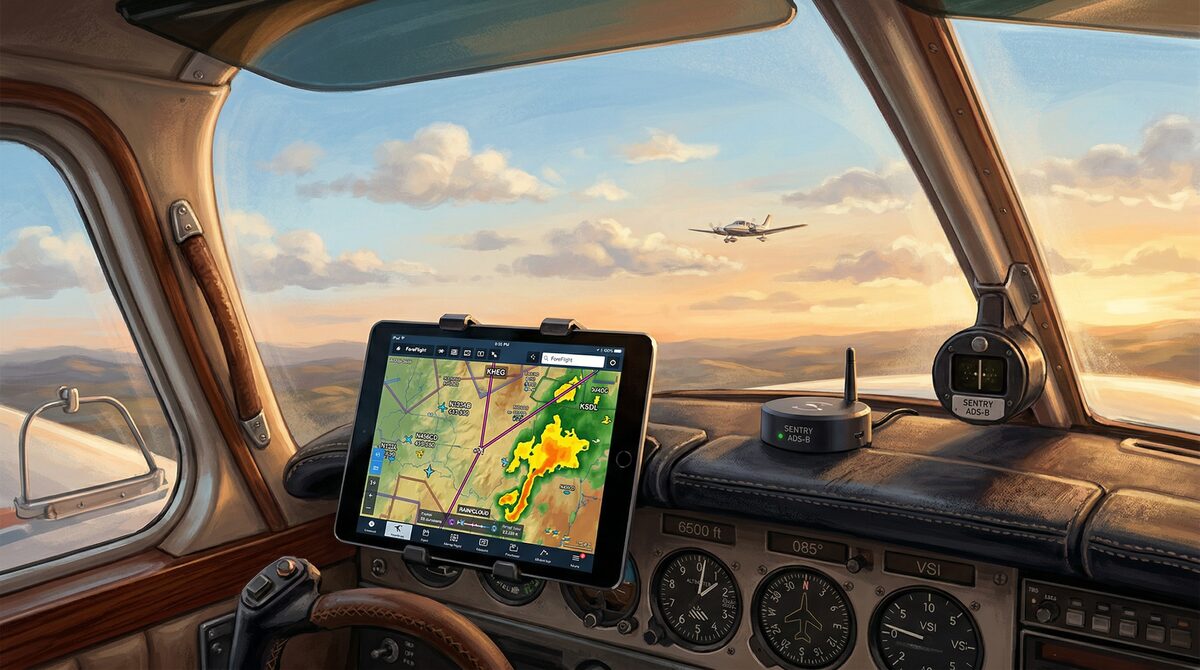
Since January 2020, ADS-B Out has been required in most controlled airspace. But ADS-B In, the ability to receive traffic and weather data in the cockpit, remains optional. If you're not using it yet, you're missing out on one of the most significant safety upgrades available to GA pilots.
What ADS-B In Gives You
ADS-B In provides two categories of data: Traffic Information Service-Broadcast (TIS-B) and Flight Information Service-Broadcast (FIS-B). TIS-B shows you nearby aircraft on a display in your cockpit. FIS-B delivers weather radar, METARs, TAFs, PIREPs, NOTAMs, and TFRs directly to your panel or tablet.
That weather radar alone is worth the investment. NEXRAD data displayed on your moving map gives you a real-time picture of precipitation and storm cells along your route. It's not perfect (there's a latency of several minutes), but it's dramatically better than flying blind.
Receiver Options
You don't need a panel-mount installation to get ADS-B In. Portable receivers like the Sentry, Stratus, and SkyEcho connect to tablets running ForeFlight or Garmin Pilot. They sit on the glareshield, run on battery power, and deliver full TIS-B and FIS-B data. Most cost between $300 and $600. For the safety benefit, that's a bargain.
Important Limitations
ADS-B traffic data has a critical limitation: it only shows you aircraft that are transmitting ADS-B Out or that are being interrogated by radar and rebroadcast via TIS-B. Aircraft without transponders (or with them off) are invisible. This means ADS-B In supplements see-and-avoid. It does not replace it.
Similarly, NEXRAD weather data has a 5 to 15 minute latency. Convective weather can develop and move significantly in that window. Use ADS-B weather for strategic planning, not tactical penetration of storm cells. If a line of weather is on your display, it's already somewhere else by the time you see it.