

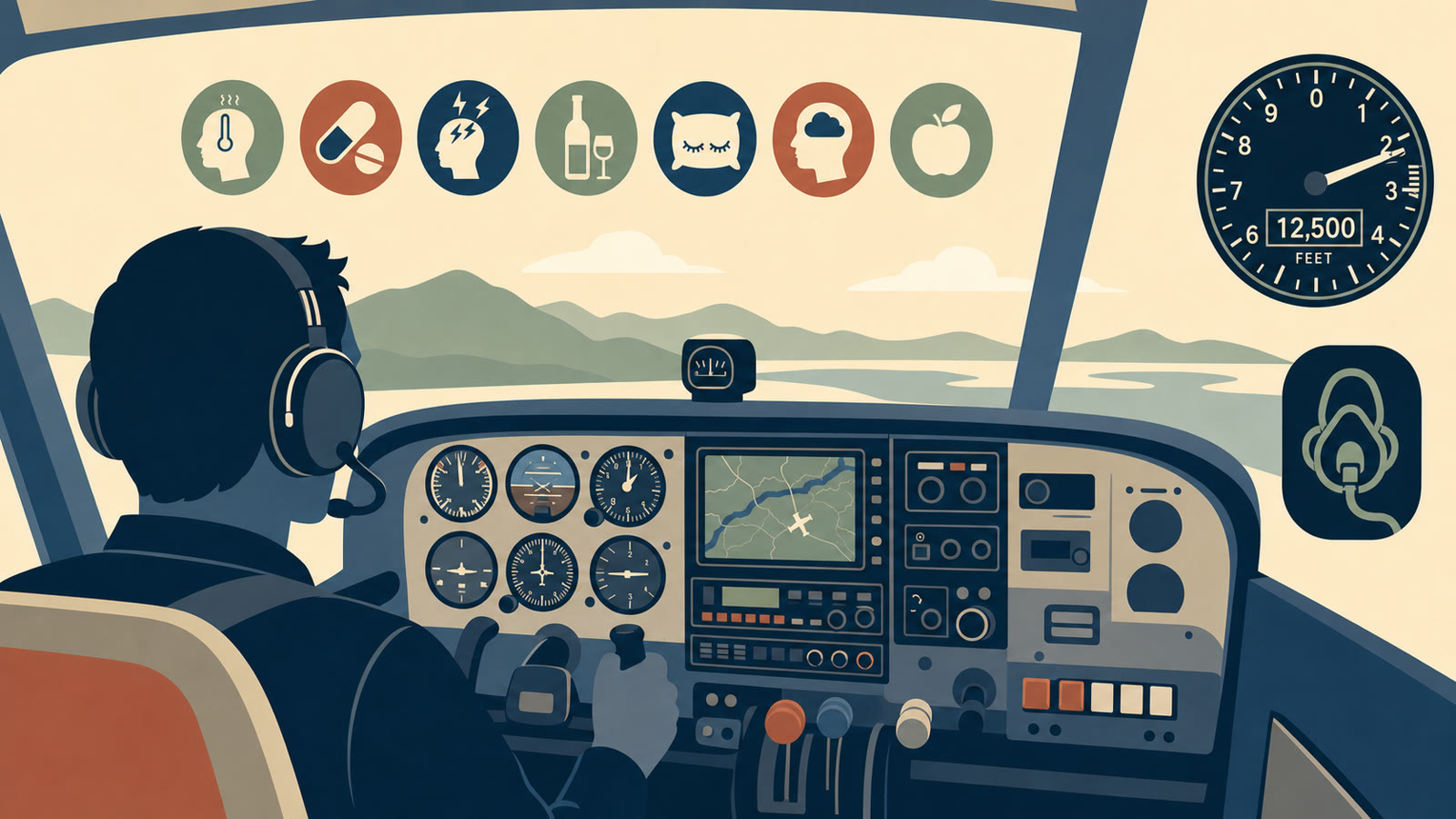
Ground school often treats aeromedical factors as a lecture to get through before the written test: memorize the definitions, answer a few questions about hypoxia, move on to weather theory. That approach misses the point. Aeromedical factors are the physical and psychological conditions that show up on a normal Tuesday lesson, on solo day, and on checkride morning. A student who skipped breakfast, slept five hours, and is nursing a cold is dealing with three aeromedical factors before the airplane leaves the ramp.
The FAA's Pilot's Handbook of Aeronautical Knowledge, Chapter 17: Aeromedical Factors, defines this material as the physiological and psychological conditions that affect pilot performance, including hypoxia, hyperventilation, spatial disorientation, motion sickness, carbon monoxide poisoning, stress, fatigue, dehydration, and the effects of alcohol and medication. Nearly every one of these will brush up against a student pilot at some point in training, usually in a mild form that is easy to miss without knowing what to look for.
This post covers what actually shows up during primary training: the IMSAFE self-check, hypoxia and its related conditions, spatial disorientation and visual illusions on approach, motion sickness, alcohol rules, dehydration, and the medication questions that come up constantly during cold and allergy season.
The IMSAFE Checklist
The standard self-assessment tool for personal fitness to fly comes from PHAK Chapter 2, Aeronautical Decision Making. IMSAFE is a six-item checklist: Illness, Medication, Stress, Alcohol, Fatigue, Emotion. It is meant to be run honestly, before every flight, not just recited for an examiner.
- Illness. Even a mild cold matters in an airplane. Stuffy sinuses and blocked ears do not equalize pressure at altitude the way they do on the ground, and a manageable head cold can turn into painful ear or sinus blocks during a descent. A student who feels "a little off" should treat that as data, not something to push through.
- Medication. This is the one students underestimate most. Common over-the-counter allergy and cold medications, including sedating antihistamines like diphenhydramine (Benadryl), carry grounding periods measured in days, not hours. This gets its own section below.
- Stress. Checkride week is the obvious example, but ordinary life stress carries into the cockpit too: a bad exam grade, a fight with a roommate, financial pressure. Task saturation during early solo work compounds it quickly.
- Alcohol. Covered by regulation, not just judgment. See the alcohol section below for the exact numbers.
- Fatigue. Showing up for an early lesson after a short night of sleep is common, especially around exam weeks. Fatigue degrades decision-making well before it feels like sleepiness.
- Emotion. Pre-solo excitement, post-solo adrenaline, and checkride nerves are emotional states that affect judgment and hand-eye coordination. A student too excited to think clearly is not ready to fly, even if nothing is technically wrong with them.
The value of IMSAFE is not the acronym. It is the habit of pausing before engine start and answering each question honestly, even when the answer is inconvenient. A CFI cannot run this checklist for a student; it only works if the student runs it silently, every time, without being asked.
Hypoxia
PHAK Chapter 17 describes hypoxia as a state of oxygen deficiency in the body sufficient to impair functions of the brain and other organs. It breaks hypoxia into four types:
- Hypoxic hypoxia. Not enough oxygen reaches the blood, typically because the ambient air pressure is too low. This is the type most associated with altitude.
- Hypemic hypoxia. The blood cannot carry enough oxygen even though the lungs are taking in a normal amount. Carbon monoxide poisoning is the classic cause, since carbon monoxide binds to hemoglobin far more readily than oxygen does. Blood loss and anemia are other causes.
- Stagnant hypoxia. Oxygen is present but blood flow to tissues is reduced or blocked, as can happen with high G-forces or poor circulation.
- Histotoxic hypoxia. The cells themselves cannot use the oxygen that is delivered, which can result from alcohol or certain drugs.
For most student pilots flying trainers well under the oxygen-mandatory altitudes, hypoxic hypoxia matters mainly on longer cross-country legs at higher cruise altitudes or on mountain flights. 14 CFR 91.211 sets the supplemental oxygen requirements every student should know cold: the required minimum flight crew must use supplemental oxygen above 12,500 feet MSL up to and including 14,000 feet MSL for any portion of flight lasting more than 30 minutes, must use it for the entire time above 14,000 feet MSL, and every occupant on board must be provided supplemental oxygen above 15,000 feet MSL.
Symptoms build gradually and include cyanosis (a bluish tint to lips and fingernails), headache, decreased reaction time, impaired judgment, visual impairment, and, in a deceptively pleasant twist, euphoria. That euphoric sense of well-being is exactly why hypoxia is dangerous: a hypoxic pilot often feels fine, even great, while judgment and reaction time are already degraded.
PHAK Chapter 17 includes a table of Time of Useful Consciousness: the period during which a person can still make rational decisions and act on them without supplemental oxygen. At 22,000 feet MSL it runs 5 to 10 minutes. At 25,000 feet it drops to 3 to 5 minutes. At 28,000 feet it falls to roughly 2.5 to 3 minutes, shrinking further above that. Symptoms increase in severity and useful consciousness time drops fast as altitude increases above 10,000 feet. The treatment for suspected hypoxia is immediate: descend, and use supplemental oxygen if available.
Hyperventilation
Hyperventilation is essentially the opposite mechanical problem with a similar result. Per PHAK Chapter 17, hyperventilation is the state of over-breathing that disrupts the normal balance of oxygen and carbon dioxide in the body. It is usually triggered by stress, anxiety, or fear rather than by low oxygen availability.
The dangerous part is that hyperventilation produces symptoms that closely mimic hypoxia: lightheadedness, tingling in the extremities, and impaired judgment. A student breathing fast and shallow during an anxious early solo pattern lesson can develop these symptoms at pattern altitude, where hypoxia should not be a factor at all, which can cause confusion about what is actually happening. The treatment is to consciously slow the breathing rate. Talking aloud, such as reading back a checklist, is an effective way to normalize breathing, and breathing into a paper bag is also a recognized method for restoring the carbon dioxide balance.
Carbon Monoxide Poisoning
Carbon monoxide is colorless and odorless, which is precisely what makes it dangerous in a piston aircraft. PHAK Chapter 17 identifies exhaust leaks as the primary source, and the cabin heating system, which draws air across a heat exchanger near the exhaust manifold, is the most common path for it to enter the cabin. A cracked exhaust component or a failed heat exchanger can introduce carbon monoxide into the air a student is breathing with no obvious warning sign.
Because carbon monoxide binds to hemoglobin more readily than oxygen, it produces a hypemic hypoxia, reducing the blood's ability to carry oxygen regardless of how much is available in the cabin air. Symptoms include headache, drowsiness, and dizziness, easy to mistake for ordinary fatigue. The correct response is fresh air immediately: turn off the cabin heat, open vents or a window if available, and use supplemental oxygen if it is on board. A low-cost carbon monoxide detector in the cockpit is an effective way to catch this before symptoms set in, and many flight schools require one in older trainers with heater-based cabin heat.
Spatial Disorientation
Spatial disorientation is the inability to correctly interpret aircraft attitude, altitude, or airspeed in relation to the earth. PHAK Chapter 17 groups the underlying illusions into three broad categories:
- Vestibular illusions. These come from the inner ear misreading motion. The leans, a false sensation of banking, is one of the most common. The graveyard spiral involves a prolonged coordinated turn that the inner ear stops registering, followed by disorientation when the pilot tries to level the wings and instead tightens the spiral. Coriolis illusion occurs when a pilot moves their head abruptly during a turn, producing a sudden, intense sense of rotation.
- Visual illusions. These come from misinterpreting what is seen outside the aircraft, including false horizon illusions caused by sloping cloud decks or ground lighting patterns, and the black hole approach at night, covered in more detail below.
- Somatogravic illusions. These come from the inner ear misreading acceleration as pitch. The elevator illusion, caused by sudden vertical acceleration such as an updraft, and inversion illusions, caused by an abrupt transition from climb to level flight, both fall in this category.
Students are especially vulnerable to spatial disorientation at night and in instrument conditions, precisely where outside visual references are degraded or absent and the inner ear's motion sense becomes unreliable. The mitigation the handbook stresses is unambiguous: trust the instruments. The attitude indicator, airspeed indicator, and altimeter are telling the truth even when the body is not.
Visual Illusions on Approach
A closely related set of illusions shows up specifically during landing approaches, and nearly every student encounters one at some point when transitioning between airports of different runway widths or flying into unfamiliar terrain. PHAK Chapter 17 covers several:
- Runway width illusion. A narrower-than-usual runway can create the illusion that the aircraft is higher than it actually is, which can lead a pilot to fly a lower approach than intended. A wider-than-usual runway produces the opposite illusion.
- Runway and terrain slope illusion. An upsloping runway or upsloping terrain can create the illusion of being higher on approach than actual, leading to a lower approach. A downsloping runway does the reverse, creating the illusion of being lower than actual.
- Featureless terrain illusion, including the black hole approach. When approach terrain lacks lights or visual references, such as over water or dark unlit terrain at night, a pilot can misjudge altitude and fly a lower approach than intended because there is nothing in the peripheral vision to calibrate against.
- Water refraction. Rain on the windscreen can create a visual effect during an approach over water that makes the aircraft appear higher than its actual altitude.
The common thread is that the eyes receive misleading information about height and distance while everything feels visually normal. Cross-checking the altimeter, VASI or PAPI lights when available, and a stabilized approach profile catches what the eyes alone will miss.
Motion Sickness
Motion sickness is common during the first several hours of flight training and nothing to be embarrassed about. PHAK Chapter 17 attributes it to a conflict between motion sensed by the inner ear and motion perceived visually, made worse when a new pilot is heads-down with charts or an instrument panel while the aircraft maneuvers.
A few habits reduce the likelihood of an unpleasant lesson: get adequate rest the night before, skip greasy or heavy food beforehand, keep an air vent open and pointed at the face, and keep the eyes on the horizon rather than down at the panel for extended periods. If a student starts feeling genuinely sick rather than just mildly queasy, cutting the lesson short and returning to the airport is the right call. Pushing through nausea does not build tolerance, it just degrades performance and makes the next lesson feel worse by association.
Alcohol and Flying
The alcohol rule is one of the few aeromedical topics governed by hard regulatory numbers rather than judgment alone. 14 CFR 91.17 prohibits operating an aircraft within 8 hours of consuming alcohol, while under the influence of alcohol, or with a blood alcohol concentration of 0.04 percent or greater. The regulation also prohibits flying while using any drug that affects the person's faculties in a way contrary to safety.
The 8-hour "bottle to throttle" figure is a legal minimum, not a guarantee of feeling fit to fly. Serious pilot errors increase dramatically at or above 0.04 percent blood alcohol concentration, and problems can occur below that threshold too. A hangover can persist past the 8-hour mark even after blood alcohol has returned to zero, and alcohol's effect on the brain's ability to use oxygen is magnified by altitude. None of the common home remedies, cold showers, coffee, or pure oxygen, speed up how fast the body eliminates alcohol. A more conservative personal minimum of 24 hours from last drink to flight, especially before an IFR flight, is worth adopting early.
Dehydration and Heat Stress
Cockpits without air conditioning heat up fast on the ramp, and cabin air at altitude is drier than most people expect. PHAK Chapter 17 covers dehydration and heat-related stress together because the symptoms overlap: fatigue, headache, and dizziness are common to both, and either one alone is enough to make a student perform noticeably worse on maneuvers that were solid the previous lesson.
Prevention is simple and often skipped: drink water before, during, and after a lesson, especially in summer heat or after sitting on a hot ramp during preflight. A student who shows up to a lesson having had only coffee that morning is starting the flight at a disadvantage before the engine even turns over.
Stress and Fatigue
PHAK Chapter 17 distinguishes acute from chronic stress and fatigue, and the distinction shapes how a student should respond. Acute stress and fatigue are short-term: a rough lesson, a bad night's sleep before a solo, a stressful exam week. These generally resolve with rest. Chronic stress and fatigue build up over weeks or months from ongoing life pressure, poor sleep habits, or overtraining, and a single good night's sleep will not fix them. Chronic fatigue in particular can degrade judgment in ways that feel normal to the person experiencing it, which makes it harder to self-diagnose.
The practical takeaway is to treat the IMSAFE fatigue and stress checks as an honest daily assessment, not a formality. A student running on five hours of sleep for two weeks straight because of a heavy course load is carrying chronic fatigue into every lesson, whether or not any single day feels unusual. Naming that condition to an instructor, and rescheduling a lesson because of it, is harder than any maneuver in the syllabus, but it is what keeps students safe.
Medications
This is the aeromedical factor students run into most often without realizing it, usually during cold and allergy season. Over-the-counter medications are not automatically safe to fly on just because they do not require a prescription. The FAA's Over-the-Counter (OTC) Medications Reference Guide is built around one core question before anything else: does the underlying condition being treated, on its own, make the pilot unsafe to fly, regardless of the medication taken for it.
Sedating antihistamines are the most common trap. Diphenhydramine (Benadryl) and doxylamine (found in some sleep aids and nighttime cold products) carry a recommended no-fly wait time of 60 hours after the last dose, and chlorpheniramine carries a 5-day wait. Non-sedating antihistamines such as loratadine (Claritin) and fexofenadine (Allegra) are generally safer choices for a pilot who needs allergy relief and plans to fly. As a general rule, the FAA recommends waiting at least 5 times the medication's dosing interval after the last dose before flying, and no pilot should fly after a new medication's first dose until at least 48 hours have passed with no side effects. The rule is not about whether a medication is legal to buy. It is about whether it is safe to fly on, and the two are frequently different answers.
Bottom Line
Aeromedical factors are not an abstract chapter to memorize for the written test. They are the cold a student flies with anyway, the allergy pill taken before a lesson, the five hours of sleep before a solo, the queasy stomach on a bumpy pattern day, and the black hole approach into an unfamiliar night airport. Every one of these shows up in normal training, usually in a mild form, and the students who handle them well are the ones who run an honest IMSAFE check every time and know the specific numbers behind hypoxia, alcohol, and medication rules rather than a vague sense of "probably fine."
None of this requires memorizing PHAK Chapter 17 word for word. It requires knowing what to watch for, knowing the regulatory limits that are not negotiable, such as the oxygen requirements in 14 CFR 91.211 and the alcohol limits in 14 CFR 91.17, and being willing to scrub or shorten a lesson when the body is sending a clear signal. That habit, built early in training, carries forward into every certificate and rating that follows.