

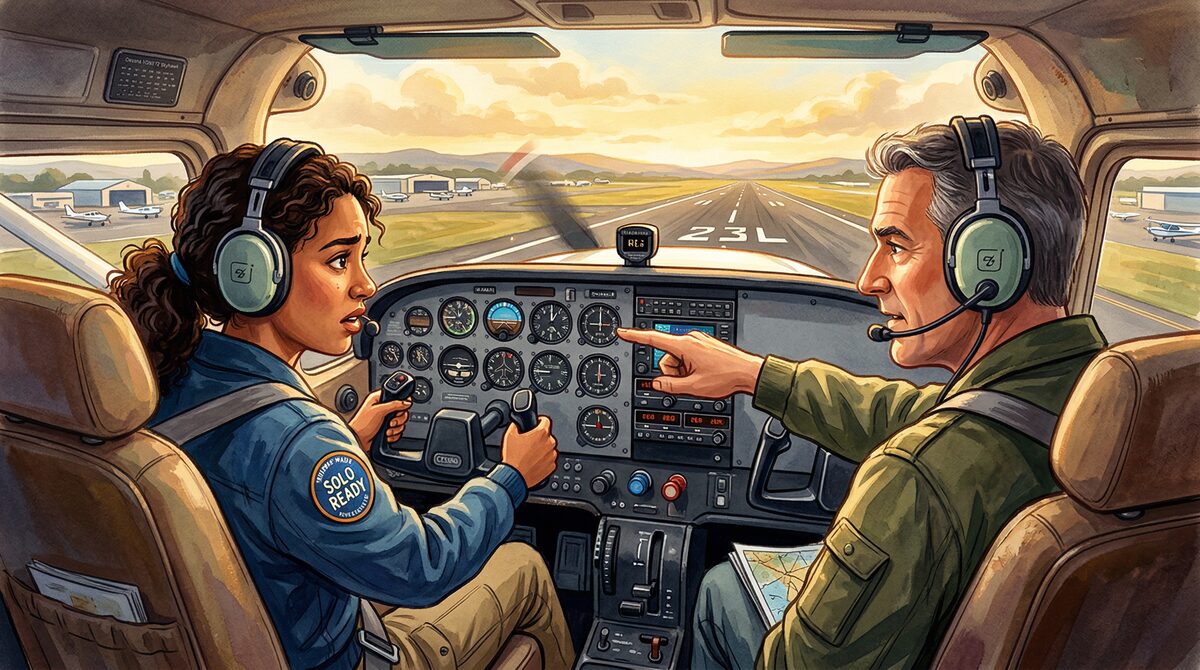
Nobody warns you about hours three through ten. They talk about solo, they talk about checkride, they talk about the freedom of flight. What they don't tell you is that the first stretch of training is genuinely disorienting — physically, cognitively, and sometimes financially. Here's what's actually happening, and why it's fine.
Your Body Will Feel Wrong
The first few hours in the cockpit, nothing feels natural. You'll grip the yoke like it owes you money. Your rudder inputs will be either nonexistent or massive, with no in-between. You'll be convinced you need more bank than you actually do, and your brain will keep insisting that something is about to go wrong when the aircraft is flying perfectly.
This is completely normal. The airplane is more forgiving than your nervous system believes. The inputs that feel enormous to you are small corrections to the aircraft. The bank angles that feel aggressive are 20 degrees. Your instincts are calibrated for the ground, where you've spent your entire life, and they'll recalibrate for the air faster than you expect — but not in the first hour, and probably not in the first five.
The fix isn't to think harder. It's to keep showing up. The physical intuition comes from repetition, not analysis. Don't fight the weirdness. Just log the hours.
The Radio Will Terrify You
Here's something most flight schools underemphasize: for the majority of student pilots, the radio is scarier than actual flying. ATC speaks fast, uses shorthand you haven't learned yet, and expects you to respond quickly with the right information in the right order. The first time you key the mic at a towered field, you will forget your own tail number.
A few things that actually help. Write it down — every clearance, every instruction, write it on your kneeboard before you read it back. Read it back slowly and deliberately. If you missed something or didn't understand, say "say again" without embarrassment. Controllers deal with student pilots all day, every day. They have heard everything. They are not judging you. What they do need is for you to not guess at a clearance you didn't catch — so ask.
The radio gets easier after about fifteen hours. Before that, it's just a skill in progress, same as everything else.
You'll Plateau and Think You're Broken
Somewhere around hours five through eight, almost every student pilot hits a wall. Progress that felt steady and real suddenly evaporates. Landings that were improving start going sideways again. You'll leave a lesson feeling worse than you did three sessions ago, and you'll wonder if you're the one person this isn't going to work for.
This is called the learning plateau, and it happens to nearly everyone. It's not failure. It's consolidation. Your brain has absorbed a significant amount of new information and new physical patterning, and it needs time to integrate before it can make the next leap forward. The plateau typically breaks on its own, usually without warning — one day you'll fly an approach and it'll click in a way it didn't before.
The worst thing you can do is stop flying during the plateau. The second worst thing is to conclude you have some fundamental deficiency. Push through it. Your instructor has seen this pattern dozens of times and can tell you whether what you're experiencing is the normal wall or something that actually needs attention.
Your Instructor Is Watching Things You Can't See Yet
When you're flying, you're focused on keeping the aircraft level, maintaining altitude, watching for traffic, and trying to remember what you're supposed to do next. Your CFI is watching all of those things — plus your scan pattern, your situational awareness, how you handle unexpected situations, whether you're ahead of the aircraft or behind it, and whether you ask good questions on the ground before and after the flight.
Students who ask "why" instead of just "what" progress meaningfully faster. Not because asking why is some magic trick, but because understanding the reason behind a procedure lets you adapt when the procedure doesn't fit the situation perfectly. A student who understands why the downwind leg exists will fly a better pattern in non-standard conditions than a student who just memorized the steps.
Your instructor is your most valuable resource in training. Use them. Ask the dumb questions. Debrief thoroughly. The hour on the ground before and after you fly is part of the lesson.
The Cost Math Will Sting, But There's a Right Way to Manage It
Flight training is expensive, and the cost compounds fast if you're not managing it actively. A lot of students end up spending more money than they need to because gaps in their training schedule force them to spend air time re-learning things they'd already got, which is the most expensive way to train.
A few things that genuinely help. Fly at minimum twice a week if your schedule and budget allow — anything less than weekly and retention drops enough to affect progress meaningfully. Study on the ground so your air time is building on what you already know, not replacing what you've forgotten. Ask your CFI for a training syllabus at the start so you can see what's coming and prepare for it. And ask about the scholarship options at your local airport — most pilots don't know they exist, and they're underutilized.
No one gets through flight training without it costing something. But there's a difference between the cost of learning and the cost of inefficiency, and you have more control over the second one than you think.
The First Solo Is Closer Than You Think
Most students spend their first ten hours waiting to feel ready for solo. That feeling never comes the way you're imagining it. "Ready" in aviation doesn't feel like confidence — it feels like competence that your instructor recognizes before you do.
What will actually happen: one day, your CFI will tell you to taxi to the ramp. They'll get out. They'll say something brief and matter-of-fact. And then they'll close the door and step back, and you'll be sitting in an airplane alone for the first time in your life. The aircraft will feel lighter with their weight gone. Your heart rate will be elevated. You will do fine.
That's what the first ten hours are building toward — not a moment of feeling fearlessly ready, but a real set of skills that are actually there when you need them. The work in those hours is less glamorous than the stories you've heard, but it's the foundation everything else sits on. Show up, ask questions, fly twice a week, and trust the process. It works.