

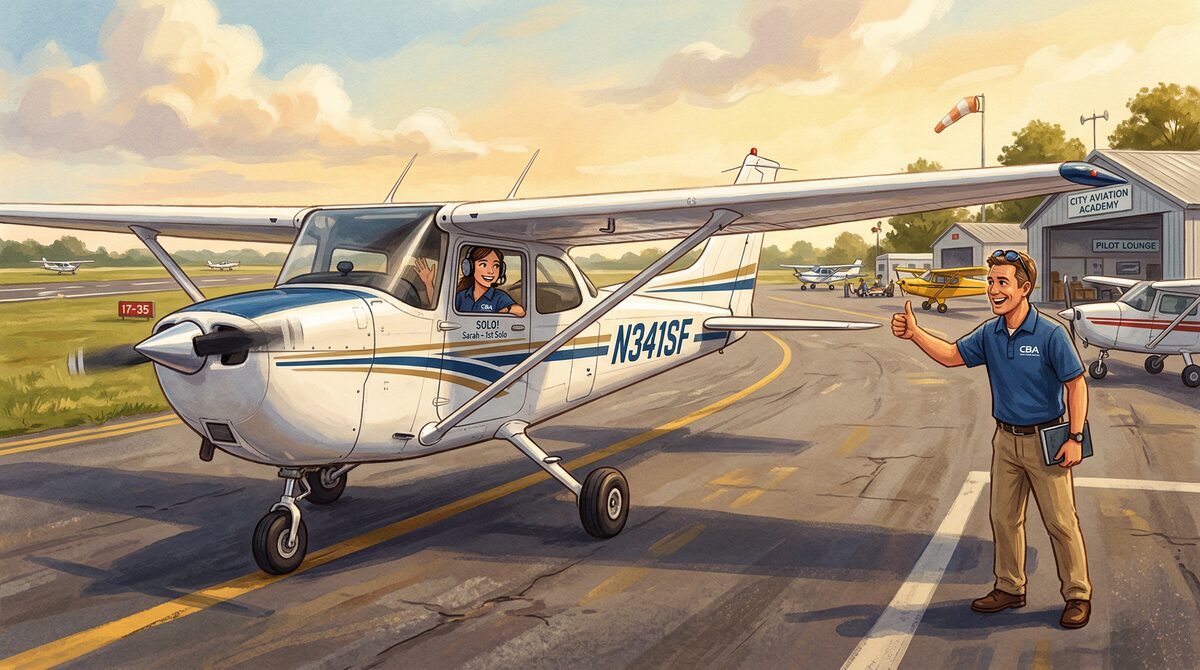
Everyone talks about the first solo as this magical, defining moment. And it is. But there's a lot about it that nobody prepares you for. Here are honest notes from the other side of that milestone.
Your Instructor Just... Leaves
You've been training for weeks. You've done dozens of touch-and-goes with your CFI sitting right there. Then one day, mid-session, they say "pull over to the ramp" and get out. They just get out. They close the door, give you a thumbs up, and walk away. The right seat is empty. The airplane feels different. Lighter, both physically and metaphorically.
The first thing you notice is how quiet it is without your instructor talking. The second thing you notice is your heart rate.
The Radio Call Hits Different
"[Airport] traffic, Cessna [tail number], student pilot, left downwind runway two-seven, [airport]." You've made that call a hundred times. Saying it solo, knowing there's nobody to bail you out, adds a weight to each word. You speak more carefully. You listen more intently. This is what it means to be pilot in command.
The Landing Will Be Your Best or Your Worst
Without the instructor's weight, the airplane performs differently. It's lighter, so it floats more in the flare. Most first solo landings are either greased (because the adrenaline sharpens your focus) or rough (because the adrenaline overwhelms your fine motor skills). Either way, you'll remember it for the rest of your life.
The Taxi Back Is the Best Part
Nobody tells you this, but the best moment isn't the takeoff, the pattern, or the landing. It's the taxi back. The airplane is on the ground, you're alive, and you just did the thing. Your instructor is grinning on the ramp. Other pilots on the frequency heard "student pilot" and they know exactly what just happened. For a brief, perfect moment, everything in aviation makes sense.
Then you remember you need to do two more landings, and the nerves come right back. That's normal. That's flying.
What the FAA Requires Before You Fly Solo
Under FAR 61.87, your instructor must endorse your student pilot certificate AND your logbook before you can fly solo. The endorsement is specific to the make and model of aircraft and the airport where you'll fly. If you solo at a towered airport, there's an additional endorsement required. These aren't formalities — your instructor is legally certifying that you've demonstrated the ability to safely fly solo, and they're putting their certificate on the line alongside yours.
The aeronautical knowledge and flight proficiency requirements for solo are laid out in FAR 61.87(b) and (d). They include stalls, emergency procedures, traffic pattern procedures, approaches and landings, and more. If you haven't reviewed those requirements with your CFI, ask to go through them. Understanding what your instructor is evaluating helps you focus your training.
What Happens to Your Body
Without a passenger in the right seat, the aircraft is measurably lighter — sometimes 150-200 pounds. That changes the aircraft's performance. The climb rate is better, the stall speed is slightly lower, and — most noticeably — the aircraft floats longer in the flare. Students who have only ever landed with an instructor in the right seat often find their first solo landing goes long. This is expected. Your CFI knows it and accounts for it in how they brief you before sending you out.
Physiologically, most students report elevated heart rate and heightened sensory awareness. Some describe it as time slowing down. The adrenaline is real and can affect fine motor control — which is why some first solo landings are rougher than the student's best dual-instruction landings. If that happens, it's not a regression. It's normal human physiology in a novel high-stakes situation.
After the Solo: What Changes
The first solo isn't the end of a phase of training — it's the beginning of a more intensive one. After solo, you'll start flying solo cross-countries, building the hours and experience required for the private pilot certificate. The FAA Airplane Flying Handbook is worth revisiting during this phase, particularly the chapters on navigation and cross-country flight planning.
Something else changes after the first solo: your relationship with the aircraft. You've proven to yourself that you can do it. The next 10-20 hours of training tend to feel different — more purposeful, more confident, more yours. The airplane stops being a machine you're operating and starts being something you fly.