

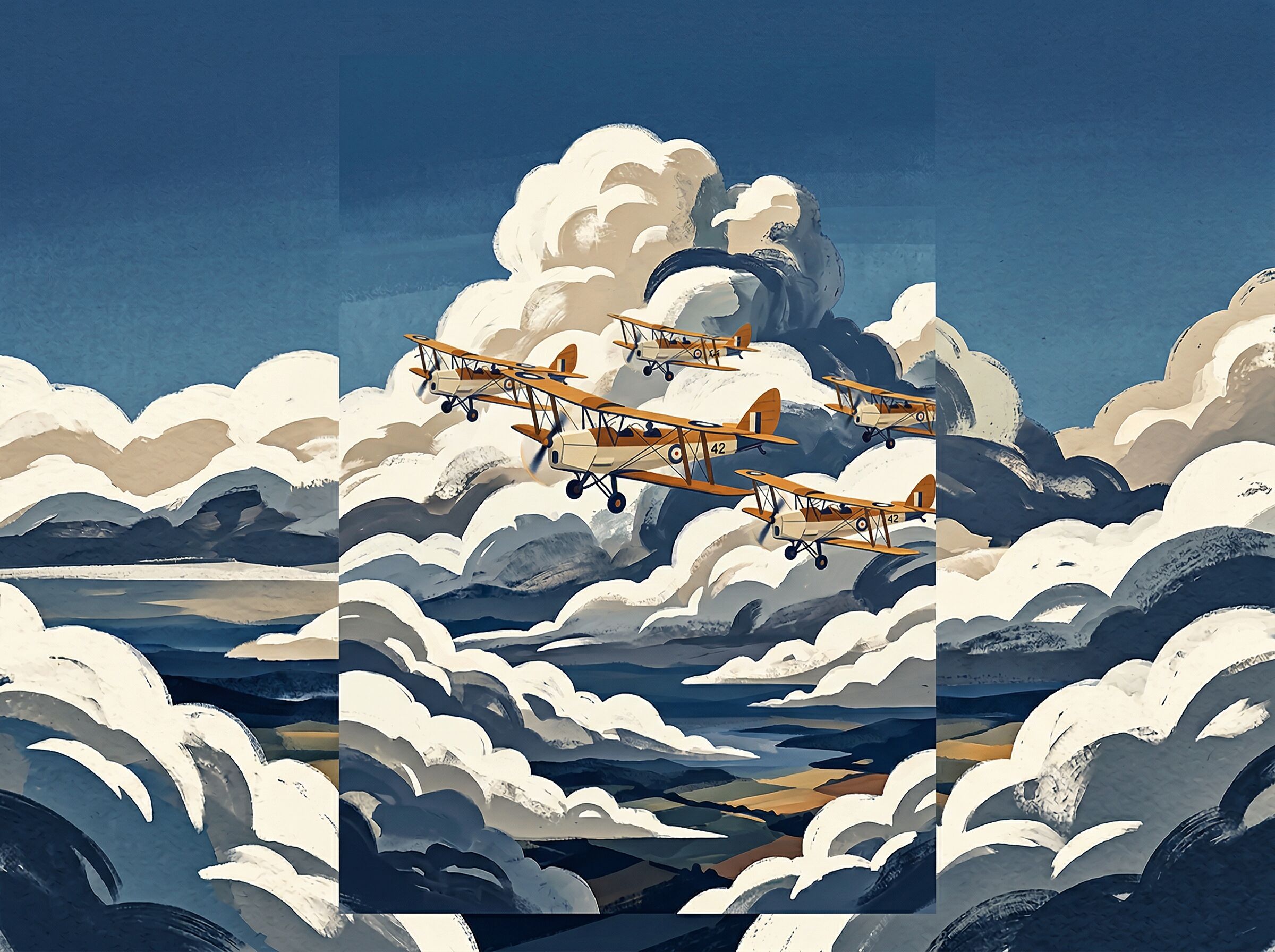
General aviation has one of the most colorful origin stories in transportation history. It didn't start with business plans and market research. It started with surplus military aircraft, open fields, and pilots who'd do anything to keep flying after the wars ended.
The Barnstorming Era (1920s)
After World War I, hundreds of surplus Curtiss JN-4 "Jennies" flooded the market. Former military pilots bought them for a few hundred dollars and took to the countryside, performing aerobatic shows and offering rides to anyone willing to pay a dollar. They called it barnstorming because they'd literally land in farmers' fields next to barns.
It was dangerous, unregulated, and wildly popular. Barnstormers introduced rural America to aviation. For many people, a five-minute ride in a Jenny was their first experience of flight. It planted the seed for what general aviation would become.
The Golden Age (1930s-1940s)
The 1930s saw the birth of purposefully designed personal aircraft. The Piper J-3 Cub, introduced in 1938, became the Model T of aviation. It was affordable, simple to fly, and tough as nails. The Civilian Pilot Training Program (CPTP) used Cubs and similar trainers to prepare thousands of pilots who would later serve in World War II.
After WWII, the pattern repeated with even more surplus aircraft and trained pilots. The GI Bill funded flight training for returning veterans. Airports sprouted across the country. General aviation boomed.
The Modern Era
The 1960s and 70s were GA's peak production years. Cessna, Piper, and Beechcraft were building thousands of aircraft annually. Then came the liability crisis of the 1980s, which nearly killed light aircraft manufacturing in America until the General Aviation Revitalization Act of 1994 provided some relief.
Today, GA is experiencing a renaissance of sorts. Glass cockpits, composite airframes, and turbine power have transformed what a small aircraft can do. Companies like Cirrus, Diamond, and Textron are pushing the boundaries. And with electric and autonomous aircraft on the horizon, the next chapter of GA history is being written right now.
The Airmail Era and the Birth of Commercial Aviation
While barnstormers were putting on shows for crowds, the U.S. Post Office was quietly building the infrastructure that would define American aviation. The Air Mail Act of 1925 (Kelly Act) transferred airmail routes from the government to private carriers, creating the financial foundation for what would become the commercial airline industry. Pilots who flew the mail routes in open-cockpit biplanes through mountain passes and prairie storms built skills and route knowledge that shaped American aviation geography for generations.
The accident rate was staggering — in the early years, one in six airmail pilots died on the job. But the routes they flew and the weather they navigated established a culture of operational seriousness that still characterizes professional aviation today.
The Safety Revolution
GA's peak production years in the 1960s and 70s coincided with a safety record that, by modern standards, was troubling. Thousands of GA accidents per year were accepted as a cost of the activity. The shift came gradually through a combination of improved aircraft systems, avionics that gave pilots better situational awareness, better weather information, and most importantly, a cultural shift toward treating aviation safety as an engineering and behavioral problem worth solving.
The NTSB's aviation accident database shows GA fatal accident rates dropping significantly from the 1980s to today. The introduction of GPS, traffic awareness systems, autopilots in light aircraft, and angle-of-attack indicators have all contributed. The FAA's WINGS program and the AOPA Air Safety Institute have driven pilot education efforts that continue today.
Where GA Stands Today
The U.S. general aviation fleet is aging — the average GA aircraft is over 40 years old — but the pilot population is more capable than ever. The FAA's Civil Airmen Statistics show roughly 700,000 certificated pilots in the United States, with sport pilot and remote pilot certificates growing the population in new directions.
The companies shaping GA's next chapter are doing things the barnstormers couldn't have imagined: Cirrus Aircraft builds composite airframes with ballistic parachutes as standard equipment. Garmin's avionics have made instrument flying accessible to a generation of pilots who trained on glass. Electric aircraft are entering the training market. And the drone ecosystem is creating an entirely new category of airman who may never sit in a cockpit but thinks about airspace, weather, and operations in ways that would be recognizable to any GA pilot.
The thread from a Curtiss Jenny in a Kansas field to a Cirrus SR22 over the Rockies is unbroken. The tools changed. The airspace got busier. The regulations got more complex. But the reason people do it — the combination of freedom, challenge, and perspective that only comes from looking down at the world from a few thousand feet — is exactly what drew crowds to those barnstorming fields a century ago.