

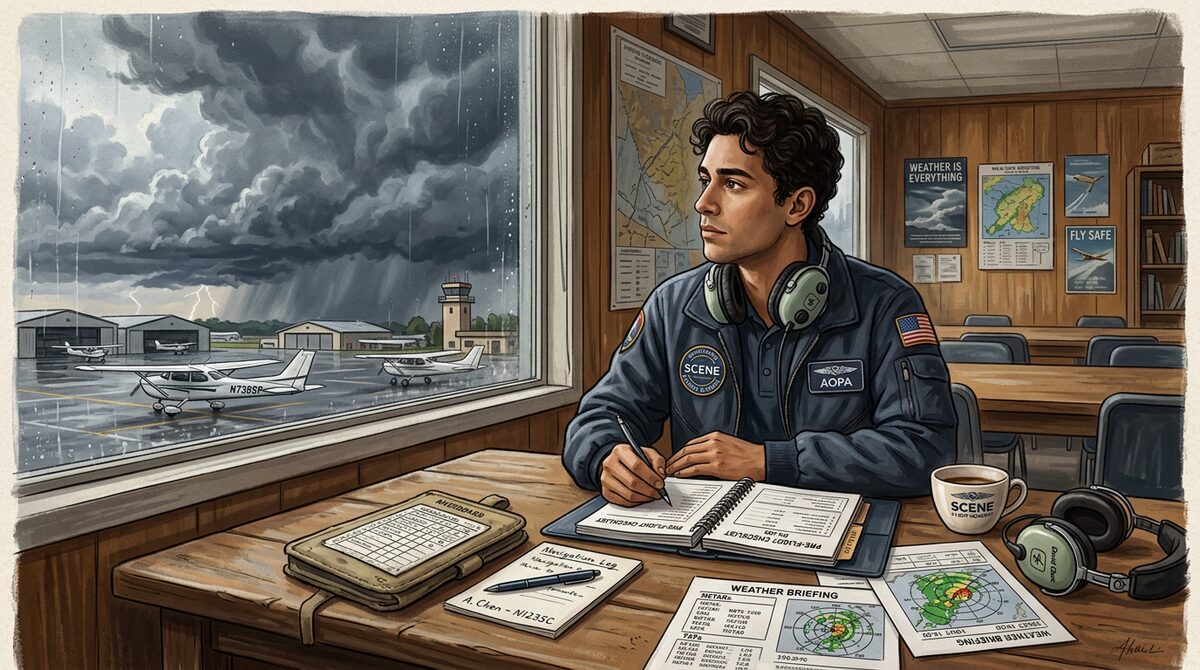
At some point in your training, your CFI will tell you that you're ready for a cross-country. Before you go, you'll sit down together and review weather, NOTAMs, TFRs, performance numbers. That conversation is the prototype for something you'll do for the rest of your flying life: the go/no-go decision.
The legal minimums are the floor. Personal minimums are the wall you build above that floor, sized to your actual experience and proficiency at this moment in your flying career. Most accidents don't happen because a pilot violated a regulation. They happen because a pilot was operating at the legal edge with insufficient margin. Personal minimums are how you prevent that.
Personal Minimums vs. Legal Minimums
The FAA Risk Management Handbook (FAA-H-8083-2A) says it plainly: personal minimums are "more restrictive than the regulatory requirements." The FAA's exact language: "Federal regulations that apply to aviation do not cover every situation nor do they guarantee safety. For example, a pilot may legally fly in marginal VFR conditions at night even though low visibility and night hazards increase the risk for an incident or accident. Therefore, pilots should consider non-mandatory self-regulation in the form of personal minimums."
That's the FAA acknowledging that the regulations are a legal floor, not a safety guarantee. You can be fully legal and still be setting yourself up for a bad outcome. Personal minimums are your self-imposed buffer.
What the Legal Minimums Actually Say
Before you can set personal minimums, you need to know what the legal floor is. Two regulations are essential here.
VFR weather minimums are in 14 CFR § 91.155. The numbers vary by airspace class. In Class E airspace below 10,000 ft MSL (where most VFR cross-country flying happens), the legal minimum is 3 statute miles visibility, with clouds at 500 ft below, 1,000 ft above, and 2,000 ft horizontal. In Class G airspace during the day, you can legally fly with 1 statute mile visibility and clear of clouds. That's remarkably little margin for a student pilot. Section 91.155(c) also prohibits operating VFR beneath any ceiling within controlled airspace designated to the surface when the ceiling is less than 1,000 feet.
Fuel reserves are in 14 CFR § 91.151. For VFR day flight in an airplane, you must have enough fuel to reach your destination plus at least 30 minutes at normal cruising speed. For night VFR, that extends to 45 minutes. These are legal minimums — they are not targets. A personal minimum for fuel reserves should be more conservative than this.
The PAVE Checklist
The FAA Risk Management Handbook (FAA-H-8083-2A) gives pilots a structured framework for evaluating risk before any flight. The PAVE checklist breaks hazards into four categories:
- Pilot — Your own health, experience, currency, mental state, and fatigue. This is the one most pilots underweight.
- Aircraft — Performance, equipment, airworthiness, and whether the aircraft is appropriate for the planned flight.
- enVironment — Weather, ATC, terrain, NOTAIDs availability, takeoff and landing surfaces, known obstacles.
- External Pressures — The purpose of the flight, how critical the schedule is, who's in the plane with you, and whether you feel pressure from anyone (including yourself) to complete the trip.
Running through PAVE before a flight is not just an academic exercise. External pressures, in particular, are responsible for a substantial share of go/no-go errors. The pressure to get somewhere — what pilots call "get-there-itis" — is well-documented in NTSB accident reports as a contributing factor in weather-related accidents. PAVE forces you to name that pressure explicitly before it gets you into the air.
The IMSAFE Checklist
PAVE's "Pilot" category gets its own dedicated tool: the IMSAFE checklist, also from FAA-H-8083-2A. It stands for:
- Illness — Any symptoms at all? Sinus congestion alone can be incapacitating at altitude.
- Medication — Prescription or over-the-counter. Many common medications have disqualifying effects on alertness or judgment.
- Stress — Financial pressure, family problems, work conflicts. Cognitive load is real, and divided attention kills.
- Alcohol — Within 8 hours? The FAA's rule is 8 hours bottle-to-throttle, but the physiological effects of alcohol last considerably longer. The Risk Management Handbook also asks: within 24 hours?
- Fatigue — Are you adequately rested? Not just "not tired enough to fall asleep," but actually alert and rested.
- Emotion — Are you emotionally upset? Grief, anger, or significant anxiety affect decision-making in ways that don't feel obvious from the inside.
A note on the "E": the current FAA Risk Management Handbook (2022 edition) defines E as Emotion, but notes that some older publications use E for Eating instead, combining Emotion and Stress. If your CFI or older study materials show E = Eating, both versions come from FAA publications. The current authoritative version uses E = Emotion.
Building Your Own Checklist
The FAA-P-8740-56 Personal Minimums Checklist gives you a fill-in framework with specific categories. The big ones every student pilot should put numbers to:
- Crosswind component — As a percentage of your aircraft's demonstrated crosswind capability per the POH. Most CFIs suggest starting at 50% and building from there.
- Ceiling — Both day and night, specified by airspace class. Don't pick a number without specifying whether you're talking about Class E, Class G, or controlled airspace — the legal floors differ significantly.
- Visibility — Again, day and night, by airspace class. 3 SM may be the legal floor in Class E, but for a new VFR pilot that's marginal. Many student pilots set a personal minimum of 5 SM or better for cross-countries.
- Fuel reserves — In hours above the legal minimums, not just the legal minimums themselves. FAA-P-8740-56 frames these in hours (e.g., "X hours VFR day fuel reserve"), which naturally pushes you above the 30/45-minute legal floor.
- Density altitude — FAA-P-8740-56 explicitly includes density altitude as a performance item under aircraft considerations. For Colorado pilots, this means setting a specific density altitude above which you won't depart without additional planning or a go/no-go from your CFI.
- External pressures — Have a written policy for when you'll call the trip and what your alternatives are. A written plan makes it easier to actually say no when the time comes.
How Your Minimums Should Evolve
The FAA Risk Management Handbook lays out a six-step process for setting personal minimums that includes a specific provision for adjusting them over time: as experience and proficiency grow, minimums can be relaxed slightly — but the adjustment should be deliberate, based on demonstrated experience, not wishful thinking. And the handbook is direct on one point: "never adjust personal minimums downward for a specific flight." If conditions require you to relax a minimum for this particular trip, that's a red flag about the trip, not a reason to revise your minimums.
Start tighter than you think you need to. As a new student pilot, your personal minimums should be significantly more conservative than what your CFI might fly. That's not lack of confidence — it's appropriate calibration to your actual experience level. As you accumulate hours, types of flights, and varied conditions, you can revisit and adjust.
The Hardest Part: Actually Saying No
Having personal minimums written down is necessary but not sufficient. The hardest moment is when someone's waiting at your destination, or you drove an hour to the airport, or the flight was planned for weeks — and the conditions are right at your limit. That's when people rationalize. "It's probably fine." "The forecast might be wrong." "I'll just take a look and turn back if it gets worse."
The NTSB accident database is full of situations that started with "I'll just take a look." Get-there-itis is not a personality flaw. It's a documented cognitive bias that affects experienced pilots as much as students. The only reliable countermeasure is a written personal minimums checklist that you've committed to before you walked out to the aircraft — one that you agreed with your past self you would honor.
The FAA Personal Minimums brochure notes that a written set of personal minimums also makes it easier to explain go/no-go decisions to passengers. When your checklist says your ceiling minimum is 2,000 ft and the forecast calls for 1,500 ft, you have something concrete to show someone who's asking why you're not going. You're not being cautious — you're following your plan.
The FAA Personal Minimums Worksheet (2022) is a good starting point if you want a structured template to work from. Print it, fill it out, and keep it with your charts.