

PPL training drowns you in acronyms. Open any chapter of the FAA Pilot's Handbook of Aeronautical Knowledge and you'll find a new one. Some are fully defined in FAA primary publications — letter-by-letter, with a direct citation. Others are folk wisdom passed down from CFI to student for decades, each version slightly different depending on where your instructor learned it. And a few are just wrong.
This post is a verified reference. Every acronym here was checked against a primary FAA source — the PHAK, the AIM, 14 CFR, or an official AOPA training publication. Anything marked as partially verified means the underlying regulation is solid but the acronym itself is an instructional shortcut, not a defined FAA term. At the end there's a short section on the four you should skip entirely.
Section 1: Risk Management and Decision Making
PAVE — Identifying Hazards Before You Start the Engine
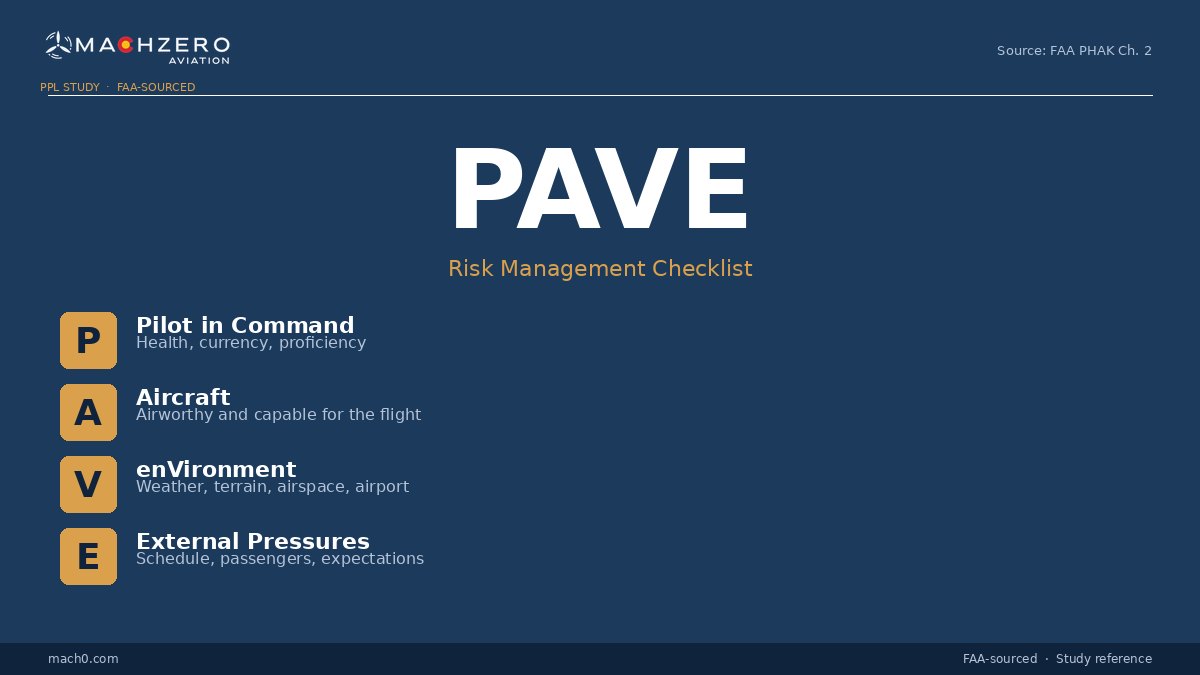
Pilot in Command • Aircraft • enVironment • External pressures
PAVE is used during preflight planning to categorize and evaluate risk. You examine each of the four categories, compare them against your personal minimums, and make a go/no-go decision. The "V" is intentionally capitalized inside "enVironment" to form the acronym. PAVE is fully defined in PHAK Chapter 2 and in a dedicated FAA PAVE brochure — this is as verified as it gets.
IMSAFE — Are You Actually Fit to Fly?
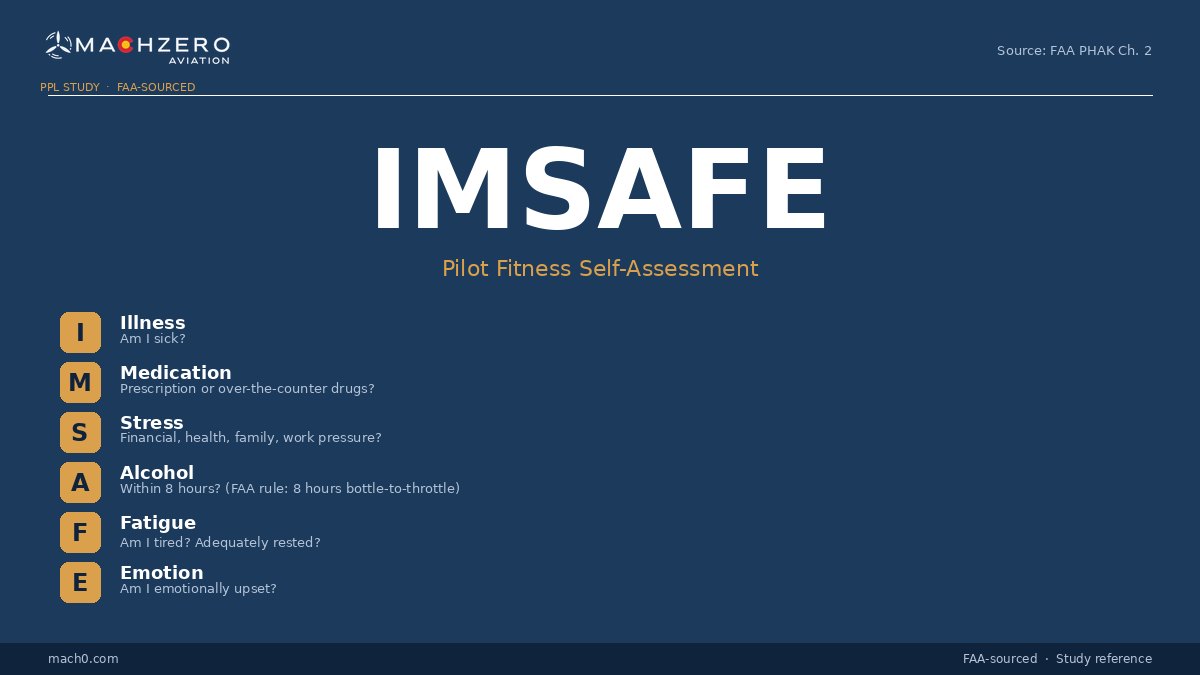
Illness • Medication • Stress • Alcohol • Fatigue • Emotion
IMSAFE is your personal fitness-for-flight self-check. You run through it before every flight and honestly answer each question — any "yes" should prompt you to consider whether it's really safe to go. One note worth flagging: the "E" is Emotion in current FAA materials (not "Eating," which circulates in some older flashcard sets). This is confirmed in PHAK Chapter 2, the FAA Risk Management Handbook, and the FAA Single-Pilot CRM document.
DECIDE — A Loop for In-Flight Problem Solving
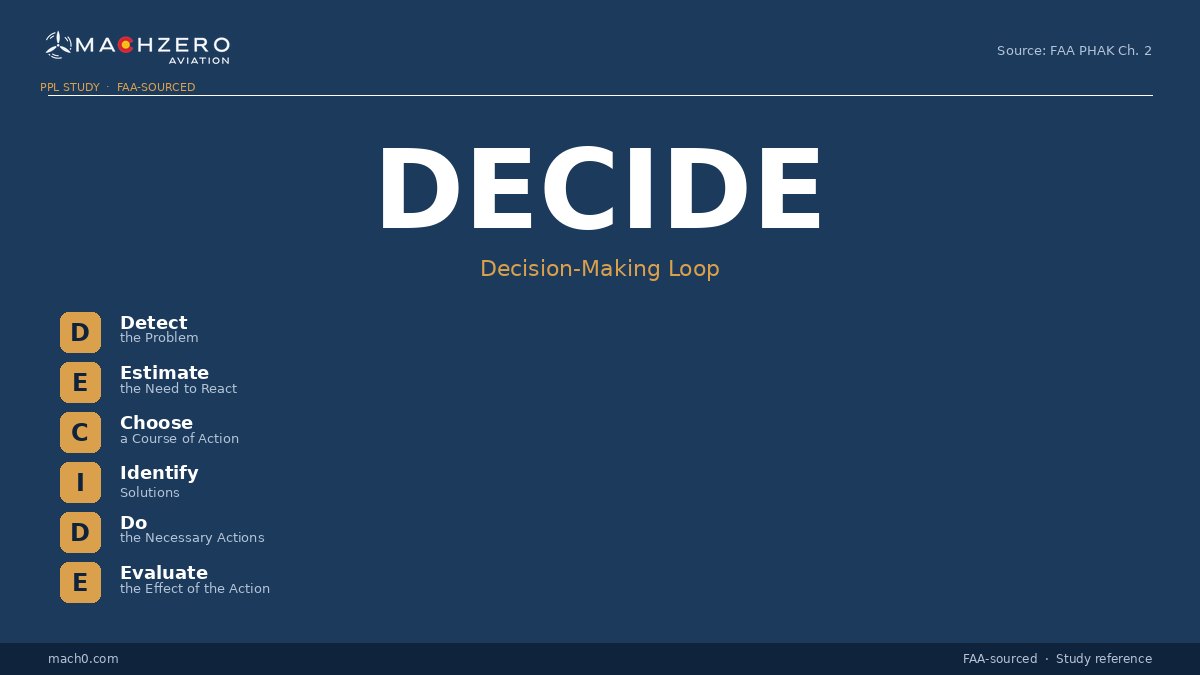
Detect the problem • Estimate the need to react • Choose a course of action • Identify solutions • Do the necessary actions • Evaluate the effect
DECIDE is a six-step decision-making model designed as a continuous loop for in-flight problem solving. When something unexpected happens, the model keeps you from skipping straight to action without thinking. It's defined by name and expanded letter-by-letter in PHAK Chapter 2.
3P Model — The FAA's Adopted SRM Framework
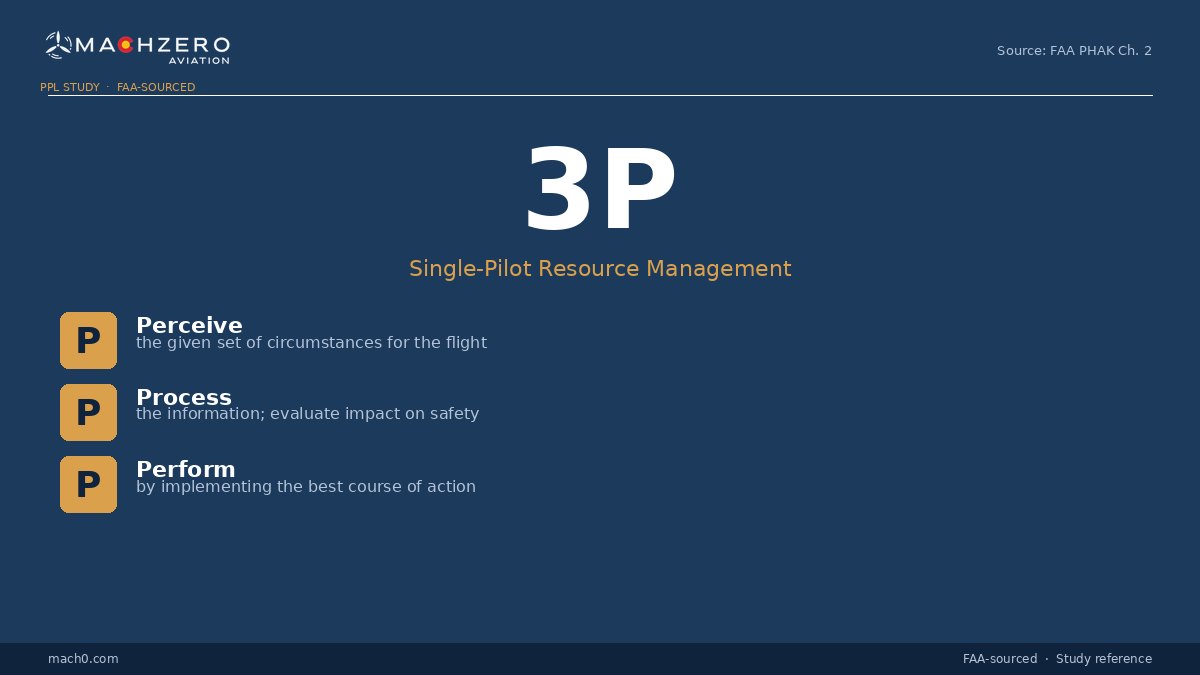
Perceive • Process • Perform
The 3P Model is the FAA's official framework for single-pilot resource management. You Perceive the set of circumstances for the flight, Process what you've gathered and evaluate its impact on safety, then Perform the best course of action. It's a cyclical process — not a one-time checklist. The FAA ADM brochure explicitly states: "To help pilots better apply the principles of ADM, the FAA adopted the 3-P Model (Perceive — Process — Perform)." It's also in PHAK Chapter 2.
5P Check — Recurring Decision Points Across a Flight
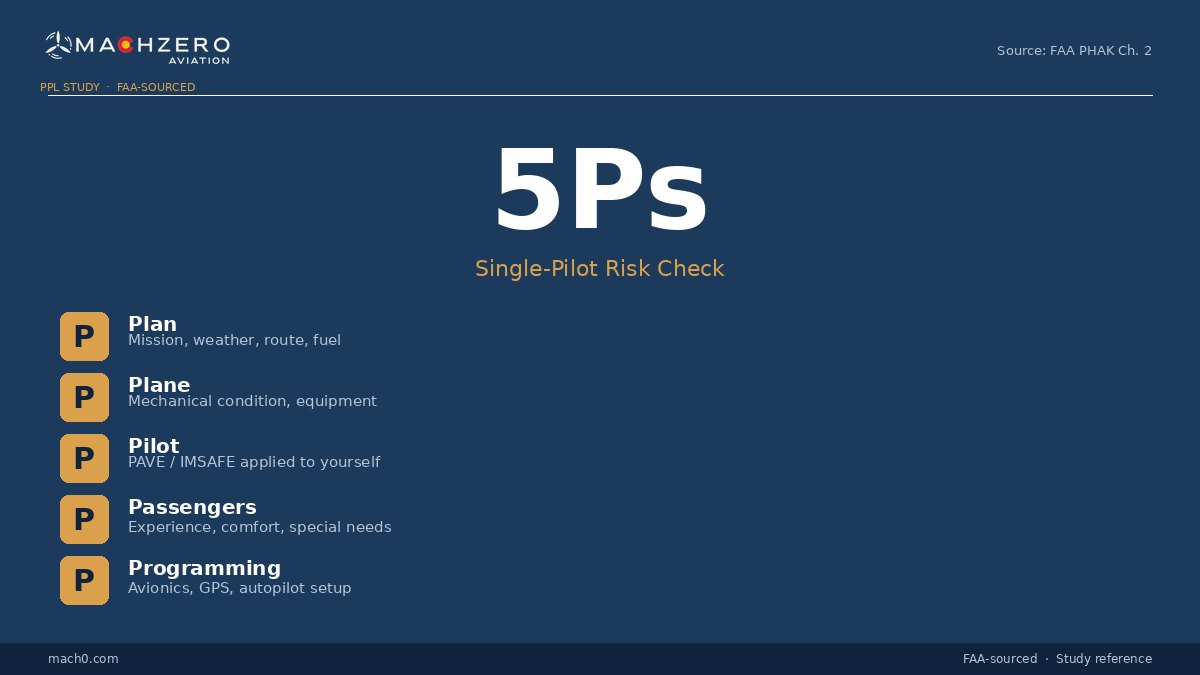
Plan • Plane • Pilot • Passengers • Programming
The 5P Check is a structured self-briefing framework used at key decision points during a flight — preflight, pre-takeoff, cruise, pre-descent, and final approach or pattern entry. At each checkpoint you evaluate whether any of the five Ps has changed enough to warrant revisiting your go/no-go decision. The "Programming" P is specifically about avionics and GPS management, which matters more than ever in glass cockpit aircraft. Defined in the FAA Single-Pilot CRM document and referenced in PHAK Chapter 2.
CARE — Analyzing What You've Perceived
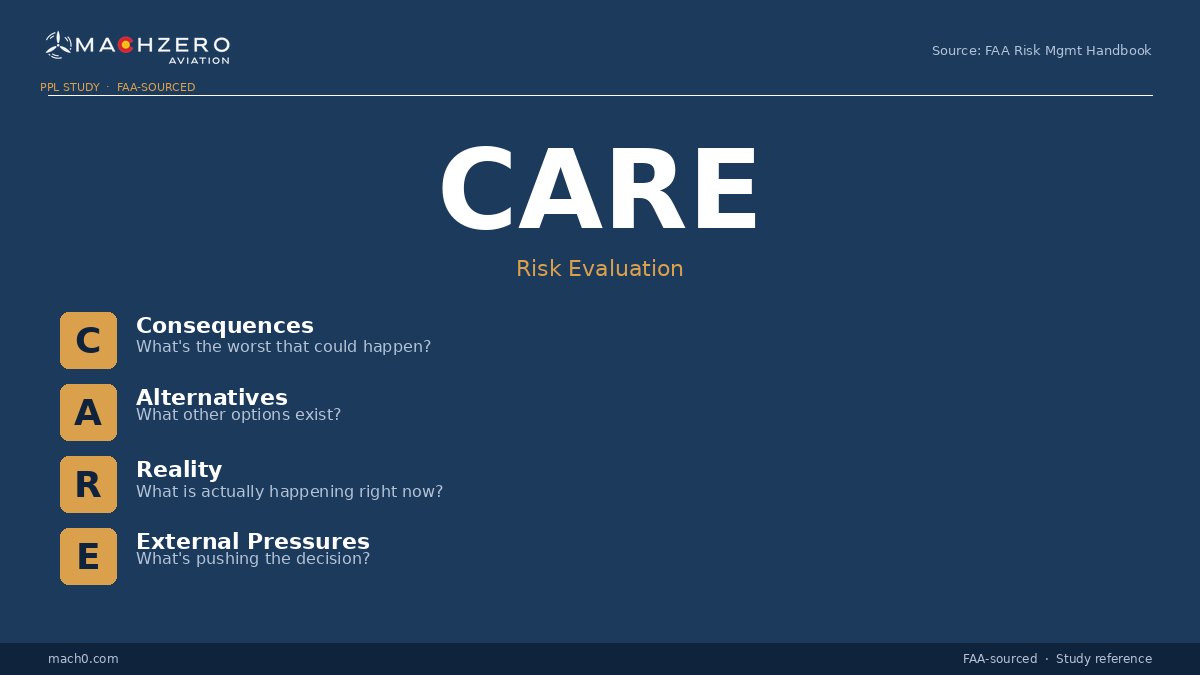
Consequences • Alternatives • Reality • External pressures
CARE is used within the 3P model as the "Process" step. After perceiving hazards with PAVE, you use CARE to analyze them: review the Consequences of each hazard, identify Alternatives that reduce risk, assess the Reality of the situation honestly, and evaluate what External pressures might be clouding your judgment. Confirmed in the FAA Risk Management Handbook (FAA-H-8083-2A).
TEAM — Choosing Your Risk Controls
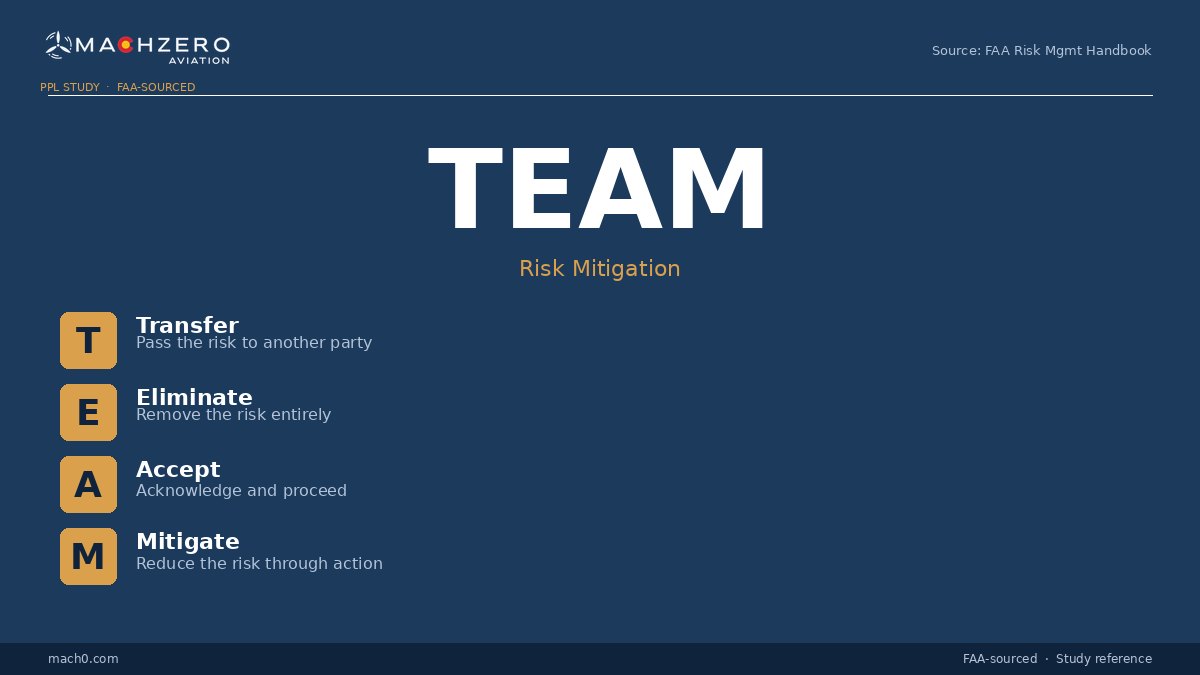
Transfer • Eliminate • Accept • Mitigate
TEAM is the "Perform" step in the 3P model. After processing hazards with CARE, you use TEAM to act on what you found: Transfer the risk (delegate, get additional instruction, or bring someone with more experience), Eliminate the hazard entirely if you can, Accept the risk if it falls within your personal minimums, or Mitigate it with additional safeguards. Also confirmed in the FAA Risk Management Handbook.
Section 2: Aircraft Documents and Inspections
ARROW — What Needs to Be in the Aircraft
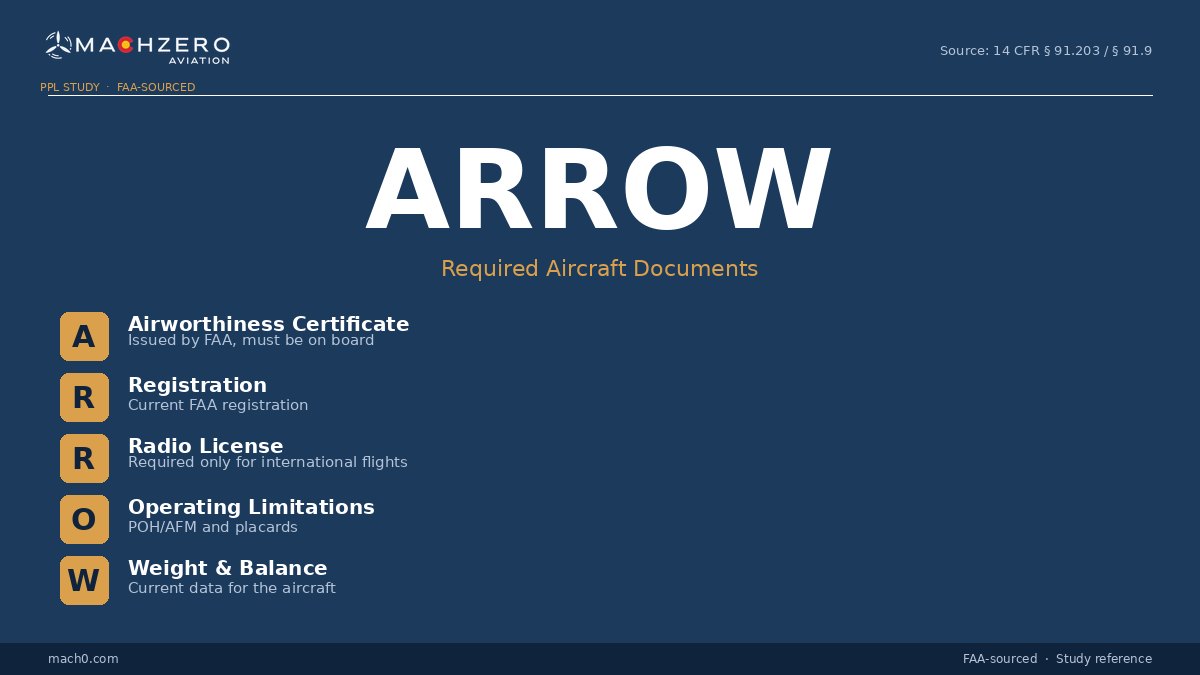
Airworthiness certificate • Registration certificate • Radio station license • Operating limitations • Weight and balance data
Each of these documents maps to a specific regulation: the airworthiness certificate and registration are required by 14 CFR 91.203(a); operating limitations and weight and balance data fall under 14 CFR 91.9. The radio station license (second R) is a common point of confusion: it's required only when operating outside the United States per 14 CFR 91.203(a)(6) — not for domestic flights. AOPA's 2024 training tip explicitly notes "radio license (international flights only)." ARROW itself is an instructional device used in AOPA official training materials; the underlying regulations are rock solid.
AAV1ATE — Required Inspections
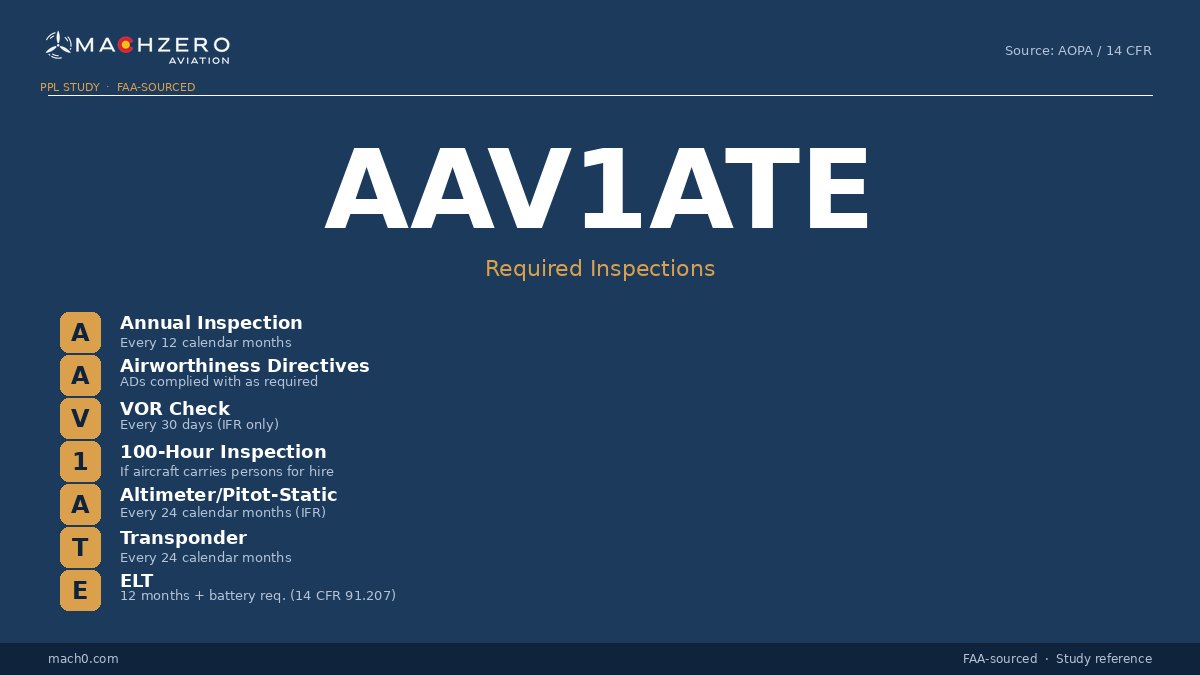
Annual inspection • Airworthiness Directives • VOR check • 100-hour inspection • Altimeter/pitot-static test • Transponder test • ELT inspection
Each letter maps to a real regulation: Annual inspection per 14 CFR 91.409(a) (every 12 calendar months); Airworthiness Directives per 14 CFR Part 39; VOR check per 14 CFR 91.171 (within 30 days, IFR only); 100-hour inspection per 14 CFR 91.409(b) (required when aircraft is used for hire); Altimeter/pitot-static per 14 CFR 91.411 (every 24 calendar months, IFR only); Transponder per 14 CFR 91.413 (every 24 calendar months); ELT per 14 CFR 91.207 (every 12 calendar months). Note that the VOR check and altimeter/static test are IFR-only requirements. The "AAV1ATE" form (with double-A to separate Annual from Airworthiness Directives) is the version used in AOPA's September 2023 instructor content; other versions (AVIATES, AV1ATE) circulate, but AAV1ATE makes the two A requirements explicit.
Section 3: Communications and Airspace
CTAF, UNICOM, ATIS, AWOS/ASOS — The Non-Tower Alphabet Soup
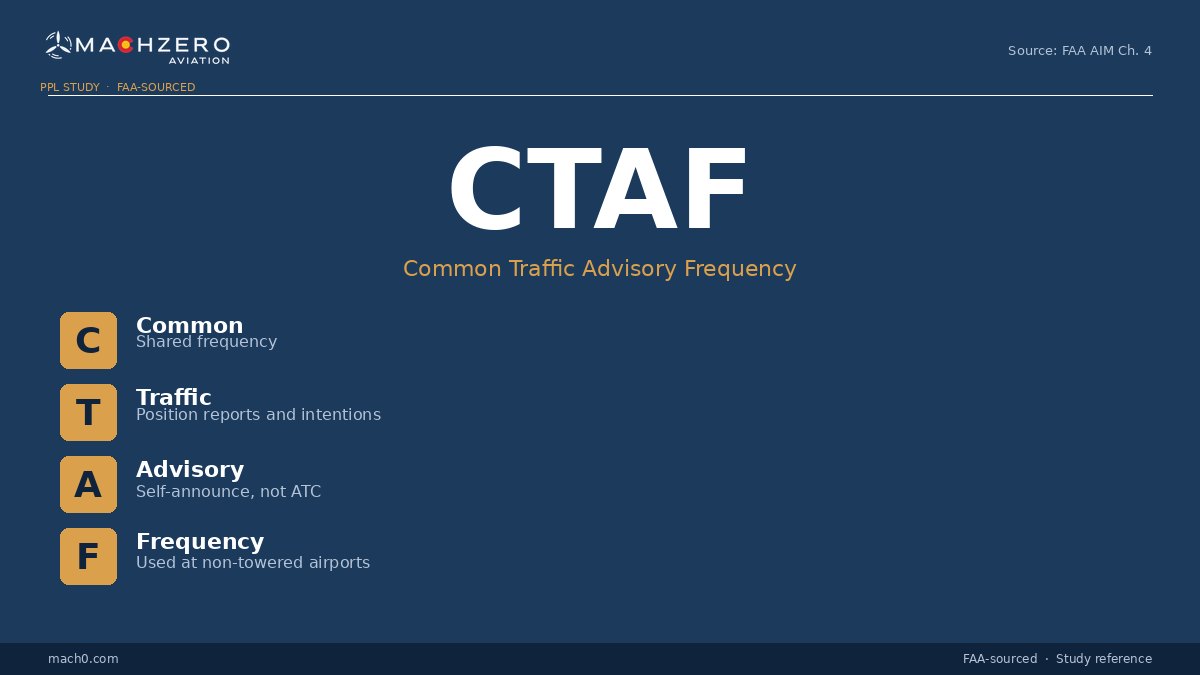
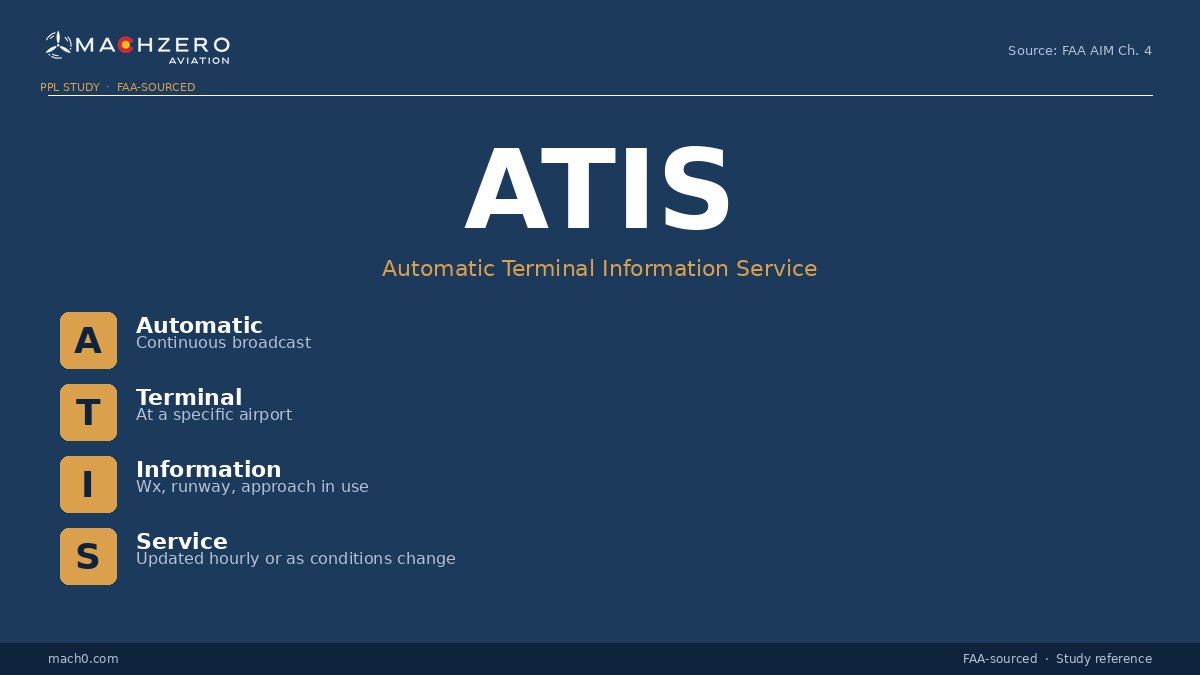
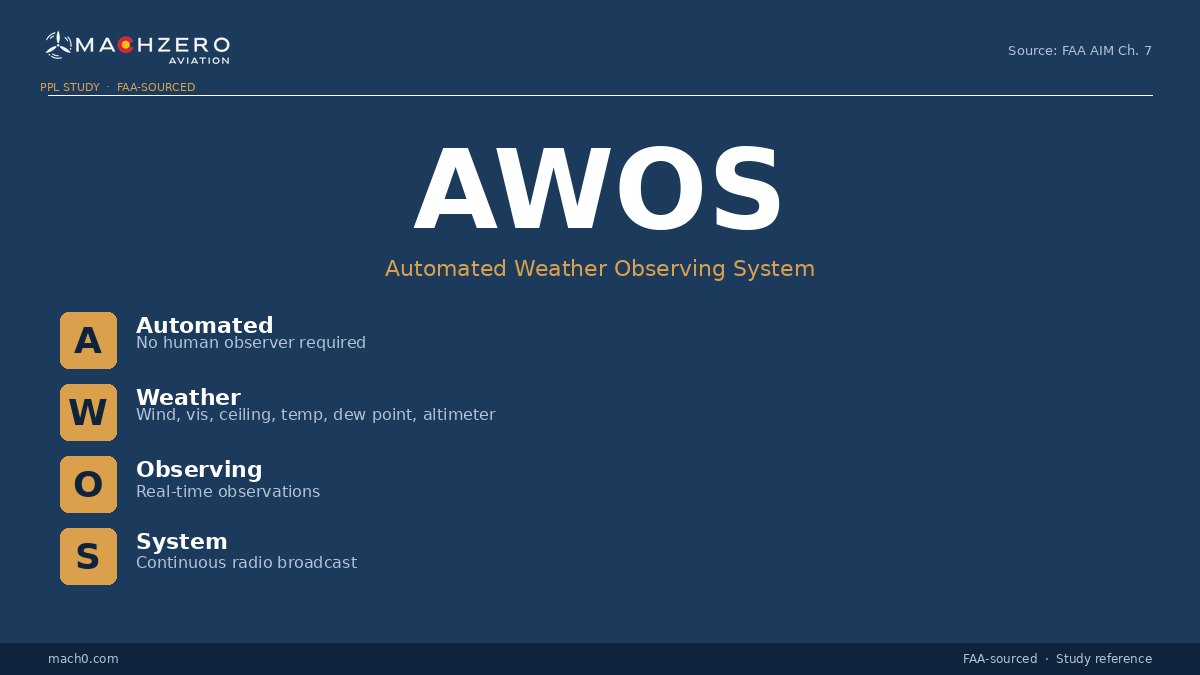
These are standard aviation abbreviations — not mnemonic devices — and all four are defined in the AIM:
- CTAF (Common Traffic Advisory Frequency) — a frequency designated for airport advisory practices at airports without an operating control tower. The AIM Chapter 4 defines it explicitly: "The acronym CTAF which stands for Common Traffic Advisory Frequency, is synonymous with this program."
- UNICOM — a nongovernment air/ground radio communication station that may provide airport information at public-use airports without a tower or FSS. Defined in AIM Chapter 4. Note: UNICOM is treated as a proper noun in the AIM — the individual letters aren't expanded.
- ATIS (Automatic Terminal Information Service) — the continuous broadcast of recorded noncontrol information in high-activity terminal areas. Defined in AIM Chapter 4.
- AWOS (Automated Weather Observing System) and ASOS (Automated Surface Observing System) — both defined in AIM Chapter 7. AWOS stations are typically FAA-owned; ASOS stations are operated by NOAA/NWS. You'll hear both in the sectional legend and on your kneeboard.
The 3-152 Cloud Clearance Rule
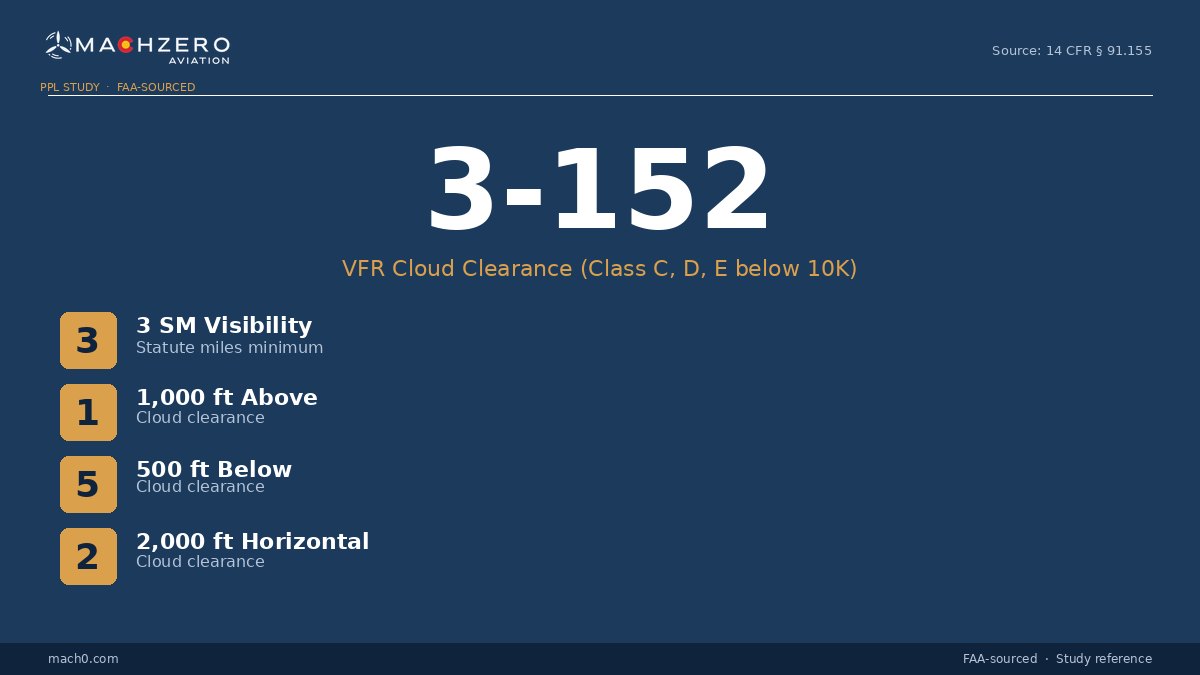
VFR in Class B, C, D, and E airspace below 10,000 ft MSL: 3 statute miles visibility, 1,000 ft above clouds, 500 ft below clouds, 2,000 ft horizontal from clouds. The "3-152" shorthand (or "C152," named after the trainer) gives you all four numbers: 3 miles, 1-5-2. The regulatory source is 14 CFR 91.155, and the FAA Balloon Flying Handbook explicitly calls it "a popular mnemonic tool."
Section 4: Operations and Emergencies
CRAFT — Copying an IFR Clearance
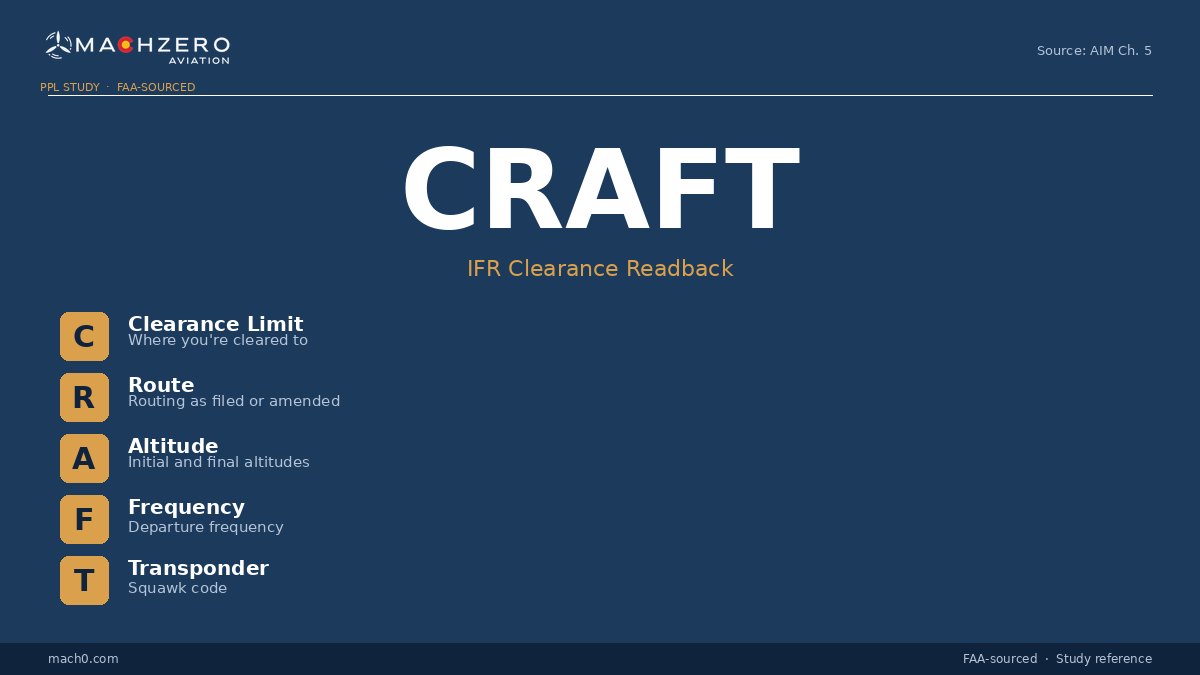
Clearance limit • Route • Altitude • Frequency • Transponder
CRAFT is the standard scratch-pad organizer for copying an IFR clearance. The "C" means the clearance limit — typically the destination airport — not "clearance" generically. The underlying clearance elements are described in AIM Section 5-2. CRAFT itself appears by name in AOPA Flight Training Magazine. It's primarily an IFR tool, but student pilots start hearing clearances in Class C and D airspace early on, so getting familiar with the format doesn't hurt.
ABCDE — Engine-Out Emergency Sequence
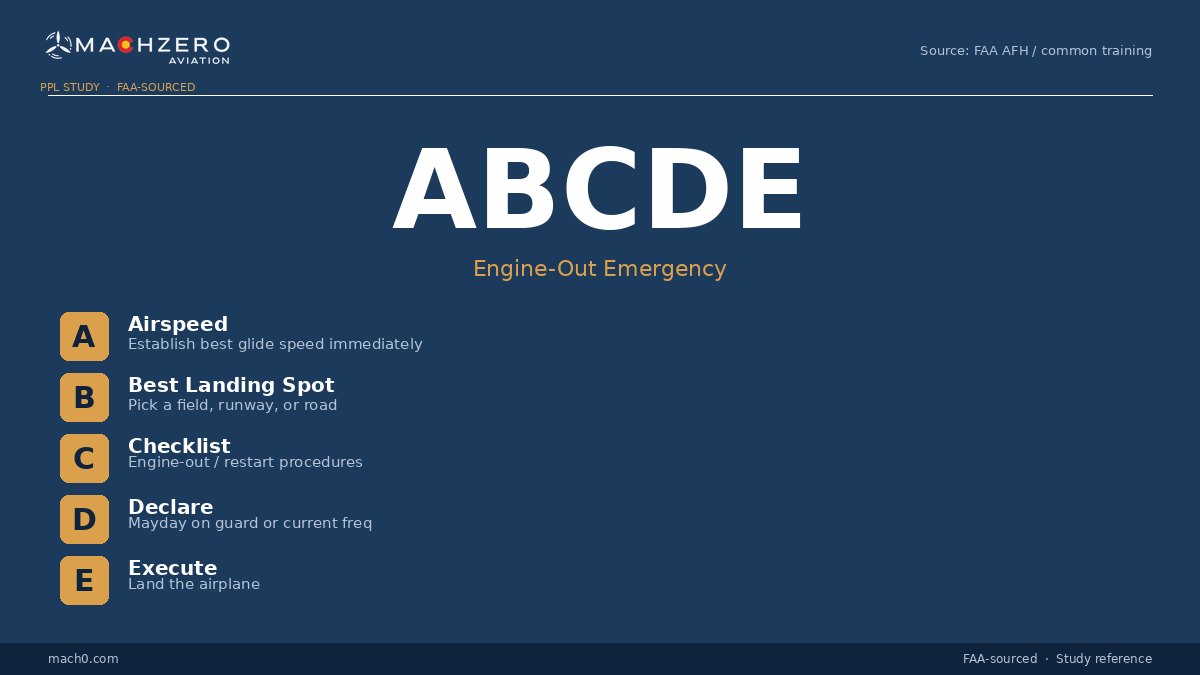
Airspeed • Best landing site • Checklist • Declare • Execute
The engine quits: establish best glide speed first (airspeed above everything else), pick a field or road, run the restart checklist, declare the emergency if time allows (squawk 7700, 121.5 MHz), then fly the approach and execute the landing. AOPA Flight Training Magazine (August 2020) confirms this sequence explicitly. One honest note: this is a well-established training mnemonic — the underlying procedures are consistent with FAA guidance in the Airplane Flying Handbook — but ABCDE is not defined as a named acronym in a single FAA handbook. The sequence is sound; just know where the citation lives.
GUMPS — Pre-Landing Check
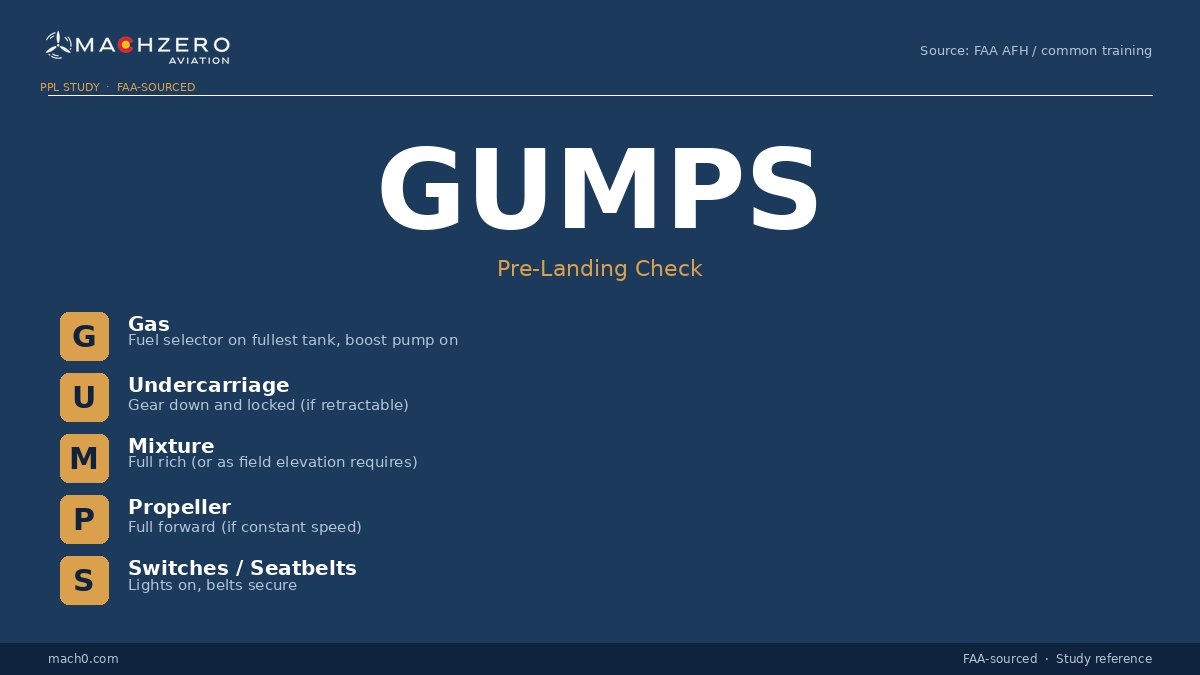
Gas • Undercarriage • Mixture • Propeller • Switches/Seat belts
GUMPS is most relevant for complex aircraft — retractable gear, controllable-pitch prop, mixture control. It's a flow check that makes sure you haven't forgotten to put the gear down. The "S" varies slightly between sources (Switches, Seat belts, Safety items) but the intent is the same. FAA Safety Briefing magazine uses "GUMPS (Gas, Undercarriage, Mixture, Props, Switches/Seatbelts)" in their Sep/Oct 2025 issue. AOPA's Flight Training Magazine describes it as "perhaps one of the most well-known mnemonic acronyms used in aviation" and notes it is "encouraged by the FAA." Not formally defined in the Airplane Flying Handbook, but FAA-encouraged and widely taught.
ANDS — Magnetic Compass Acceleration Errors
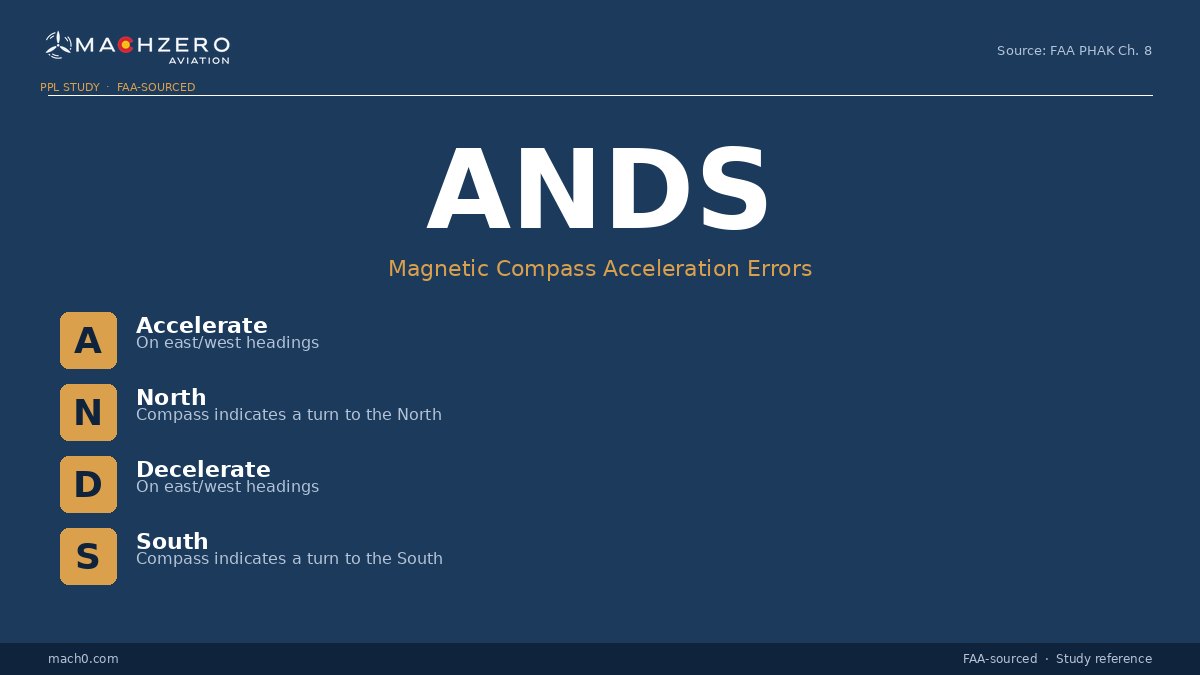
Accelerate North • Decelerate South
On easterly or westerly headings, the compass card behaves predictably but annoyingly: accelerating causes it to rotate toward North; decelerating causes it to rotate toward South. This is caused by the dip-correction weight in the compass. The PHAK Glossary on faa.gov confirms this directly: "Acceleration error — A magnetic compass error apparent when the aircraft accelerates while flying on an easterly or westerly heading, causing the compass card to rotate toward North." The ANDS mnemonic appears in AOPA Flight Training Magazine (May 2012).
OSUN — Magnetic Compass Turning Errors
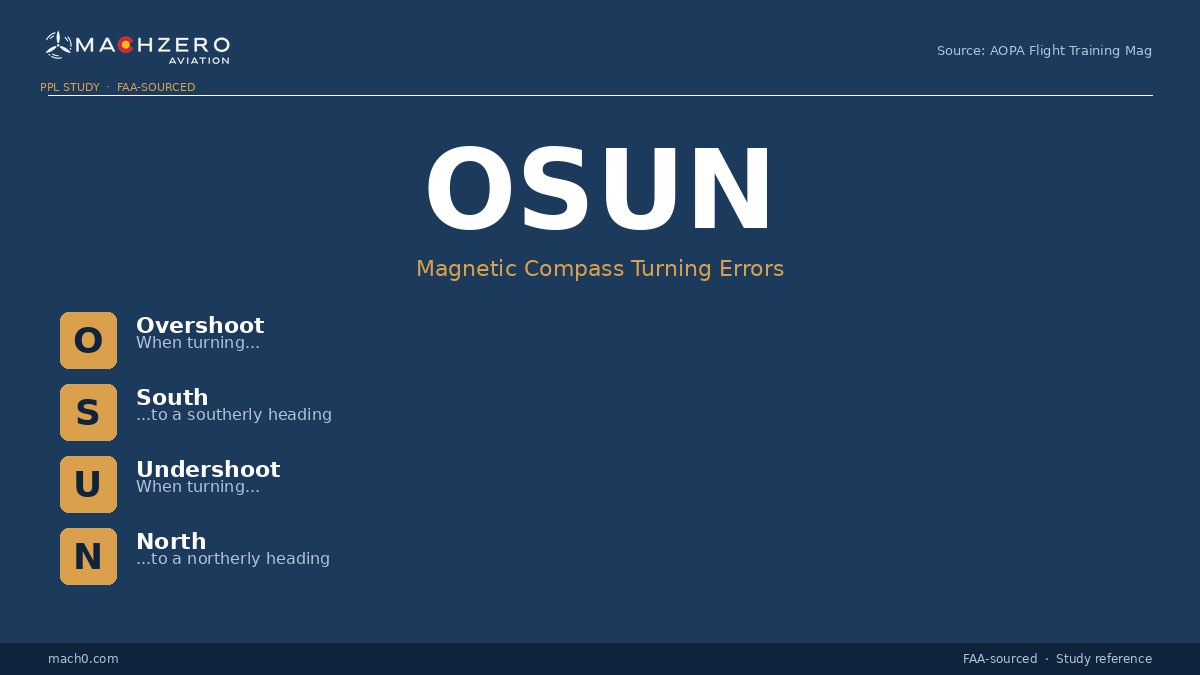
Overshoot South • Undershoot North
When turning to or from northerly and southerly headings in the northern hemisphere, the magnetic compass leads or lags. Turning to a southerly heading: the compass leads — roll out past your target heading. Turning to a northerly heading: the compass lags — stop the turn before the compass reaches your target. OSUN (Overshoot South, Undershoot North) is the verified version from AOPA Flight Training Magazine. The alternate version "UNOS" circulates widely online but was not found in AOPA or any FAA publication — more on that in the next section.
Section 5: The Acronyms to Skip
These four come up constantly in student pilot forums and flashcard decks. They're either wrong, unverified, or actively harmful because they'll get you to the wrong answer on the written exam.
UNOS — Wrong Direction, Skip It
"UNOS" (Undershoots North, Overshoots South) describes the same compass turning-error phenomenon as OSUN but reverses the letters. The problem: OSUN is the version confirmed in AOPA Flight Training Magazine. UNOS was not found in any FAA publication or AOPA source during research for this post. If you've been studying with UNOS and it's working for you, the underlying concept is correct — but if you see it on a flashcard deck with no citation, know that OSUN is the verified form.
AROW — Use ARROW Instead
AROW (Airworthiness, Registration, Operating limitations, Weight & balance) drops the radio license "R" entirely. The logic is appealing — the radio license isn't required domestically — but the acronym wasn't found as a defined term in any searched source. ARROW with the radio caveat is the standard. The correct answer on the written exam uses ARROW, and the correct teaching point is that the second R applies to international operations only.
FLAPS as a Preflight Aid — Too Many Versions
FLAPS shows up as a preflight memory aid in various informal sources, but every version has different letter expansions. No consistent or FAA-verifiable expansion was found across the sources used for this post. Use your aircraft's POH checklist instead. A preflight is not a place to improvise mnemonics.
MEFA — Not a Real Acronym
MEA is the real term: Minimum En Route Altitude, defined in 14 CFR Part 1. MEFA (sometimes written as "Minimum Enroute Fuel Altitude") appears to be an informal conflation that doesn't correspond to any defined term in the AIM, 14 CFR, or AOPA sources. If you've seen it somewhere, it's likely a typo or confusion. Use MEA.
The Real Test: When Your CFI Kills Your Engine
Here is the part nobody warns you about: memorizing these on the ground is the easy part. Reciting PAVE before a flight while you have a coffee in hand and your tablet open is one thing. Recalling the right one when your instructor reaches over mid-cruise, kills your engine, and calmly says "okay, what now?" is another sport entirely.
For me, the first few times that happened, my brain went completely blank. I knew the acronym. I had drilled ABCDE the night before. But the moment the engine went quiet and the airplane started to feel different, I could not have told you what the "A" stood for if my life depended on it. I just stared at the panel for a full second too long, then started fumbling for best glide while my instructor watched the altitude bleed off.
That gap between knowing something and being able to use it under pressure is real, and it is part of why CFIs run simulated emergencies in the first place. The fix is not more flashcards. It is more reps in the airplane. Chair fly the procedures at home. Talk through ABCDE out loud while you drive. Practice setting up best glide on every climb-out so the muscle memory is there when you actually need it. By the time your CFI tries to surprise you for the fifth time, you stop panicking and start running the checklist, because that is just what your hands do now.
The same goes for GUMPS on every approach, the IMSAFE self-check on the walk to the airplane, and the IFR clearance readback with CRAFT in your head. The acronyms are the scaffolding. The actual skill is being able to reach for them when your brain is busy trying to fly the airplane. Keep flying. Keep getting surprised. Eventually the surprise stops winning.
Bookmark This for Written Exam Prep
Every acronym in this post was checked against a primary FAA source before it made it here — PHAK, FAA Risk Management Handbook, AIM, 14 CFR, FAA Safety Briefing, or AOPA Flight Training Magazine. The ones marked "partially verified" have solid regulatory backing; they're just instructional devices rather than formally defined FAA terms, and that distinction matters for how you cite them in an oral exam.
The FAA-canonical sources linked throughout — the PHAK, the Risk Management Handbook, and the AIM — are the actual authoritative documents. These study cards are the shortcut. When your DPE asks where an acronym comes from, know the handbook, not just the flashcard.