

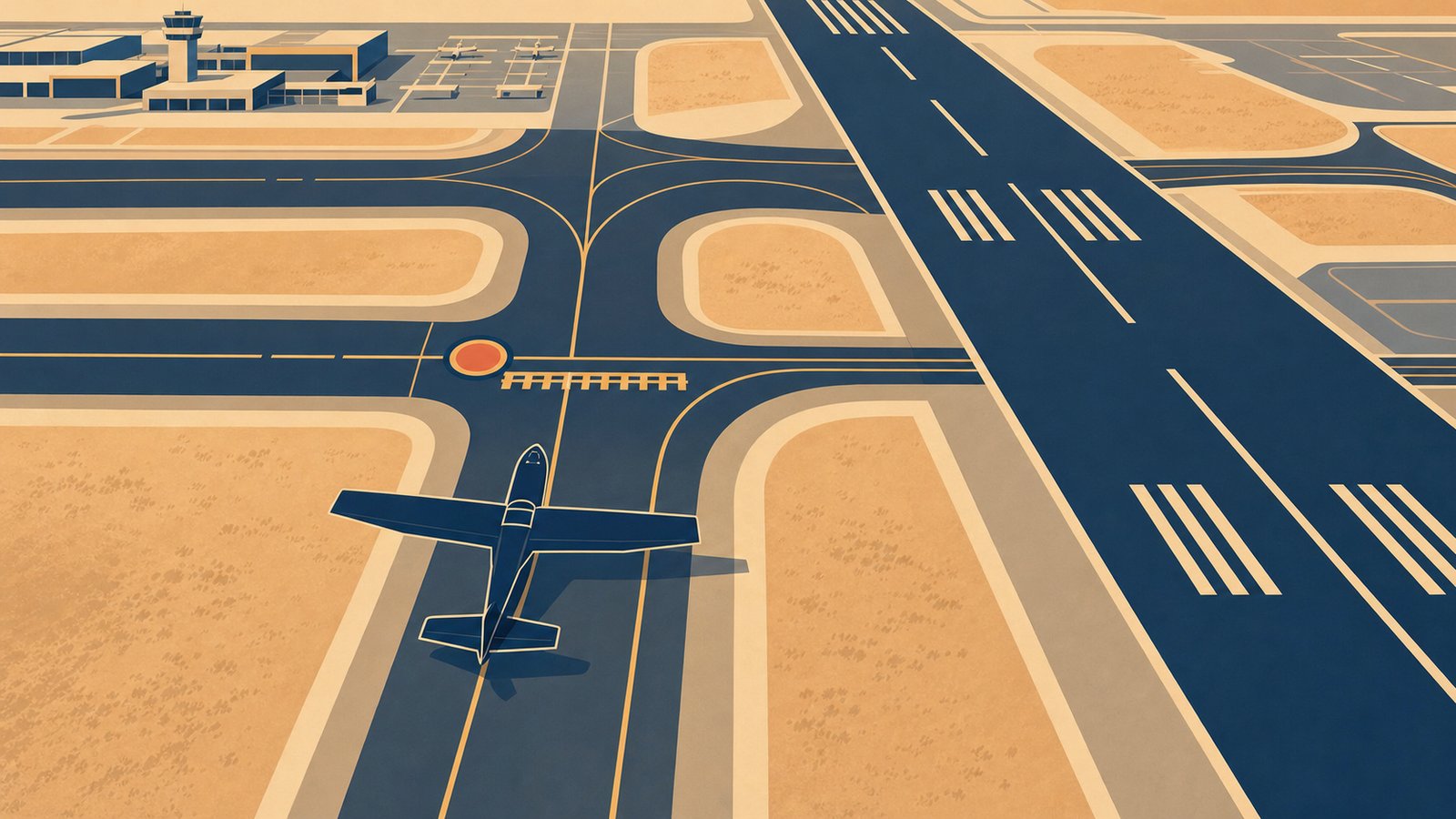
My CFI keyed the mic and told Ground we were ready to taxi. The controller came back with something like: "Cessna 12345, taxi to runway 17L via Alpha, hold short of runway 10, cross runway 17R at Bravo 8, monitor tower 118.7." I read it back, wrote it down, and we started moving. About ninety seconds later I was sitting at a yellow line staring at a sign trying to remember whether the solid stripes face toward me or away from me when I'm supposed to stop.
That moment is what this post is about. Not the radio call, not the checklist. The yellow lines on the pavement and what they mean, and the habits that keep a student pilot on the right side of them.
Runway incursions are one of the FAA's persistent top safety concerns, and they are not just an airline problem. According to a 2025 DOT Inspector General report on FAA runway incursion data, nearly 62 percent of the 1,758 total runway incursions recorded in fiscal year 2024 were pilot deviations. General aviation pilots contribute a significant share of that number. The good news is that almost every pilot deviation is preventable, and the prevention comes down to knowing the markings, understanding the clearance, and building the right habits before you ever show up at a towered airport.
What a Runway Incursion Actually Is
The FAA's official definition, per FAA runway safety resources, is: "any occurrence at an aerodrome involving the incorrect presence of an aircraft, vehicle, or person on the protected area of a surface designated for the landing and takeoff of aircraft." That definition comes directly from FAA Order 7050.1 and aligns with ICAO's international standard.
The FAA classifies runway incursions by severity from Category A through Category D. Category A is the most serious: a collision was narrowly avoided. Category B means separation decreased to the point where a significant potential for collision existed and time-critical evasive action may have been required. Category C is characterized by ample time and distance to avoid a collision. Category D meets the technical definition of an incursion but had no immediate safety consequences, typically the incorrect presence of a single vehicle or aircraft with no other traffic nearby.
The severity distribution matters. In fiscal year 2024, the FAA reported nine serious Category A and B runway incursions, representing about 0.51 percent of total incidents. Four of those nine were pilot deviations. The bulk of runway incursions are Category C and D events, but that is not a reason for complacency. A Category D is still an incursion, and the habits that produce Category D events are the same habits that, under different traffic conditions, produce Category A events.
The Regulatory Context: AC 91-73B
FAA Advisory Circular 91-73B is the primary guidance document for Part 91 pilots on taxi operations and runway incursion prevention. It covers everything from pre-taxi briefing to how to exit a runway after landing. The AC is not regulatory, but it reflects best practices the FAA considers essential, and if you fly at towered airports and have not read it, that is the first item on your list.
Two items from the AC are worth calling out early. First: pilots are required to read back all hold short instructions with the complete call sign and the runway designator. Not "wilco," not a paraphrase. The full readback. Second: the AC explicitly states that CFIs should instruct students to limit cockpit instruction during taxiing to mitigate the risk of a runway incursion. The briefing about what taxiway signs mean happens on the ground, not while rolling through an unfamiliar intersection.
Airport Surface Markings Decoded
The markings are standardized and fully described in AIM Section 4-3 and FAA Advisory Circular 150/5340-1M. Here is the set you need to know before your first controlled airport solo.
Runway vs. Taxiway Centerlines
Runway centerlines are white and dashed. Taxiway centerlines are yellow and continuous. That color difference is the single most important visual cue on the surface. If you are following a yellow line, you are on a taxiway. If you are about to follow a white dashed line, you are entering or crossing a runway. Yellow means taxi. White means runway.
Edge Markings
Runway edges are marked with continuous white stripes. Taxiway edges are yellow. When you see white edge lines on both sides of you, you are on a runway. When you see yellow, you are on a taxiway.
Runway Holding Position Markings (the Four-Line Pattern)
This is the one that confused me sitting at KAPA. The runway holding position marking is four yellow lines: two solid and two dashed. The rule is simple once you memorize it. The solid lines are always on the side from which you must hold. So when you are approaching a runway and the solid lines are facing you, stop there. You are at the hold-short line. Do not cross until ATC clears you.
The dashed lines face the runway side, meaning if you are exiting a runway and see the dashed lines facing you first, you are clear to continue taxiing off the runway without stopping. The memory aid that works for me: solid means stop.
Enhanced Taxiway Centerline Markings
At many airports, you will see yellow dashes flanking the yellow centerline for the last 150 feet or so before a runway holding position. These enhanced centerline markings are a visual warning that you are approaching a hold-short line. They serve as a heads-up: the hold line is ahead, start slowing, confirm your clearance. Per AC 150/5340-1M, these are not a substitute for the holding position marking itself. They are an early warning system.
ILS Critical Area Holding Position
When an ILS approach is in use, there is an additional holding position with a ladder pattern (sometimes called "piano key" markings). This keeps aircraft out of the area where their presence would distort the ILS signal. ATC will tell you explicitly to hold short of the ILS critical area, and that clearance is separate from a runway crossing clearance.
Non-Movement Area Boundary Markings
Two yellow lines, one solid and one dashed, mark the boundary between ATC-controlled movement area and the non-movement ramp or apron. The solid line faces the movement area. When you cross from dashed side to solid side, you are entering ATC-controlled territory.
Signage: What the Colors Mean
Airport signage follows a strict color code per FAA airport signs and markings guidance. Red signs with white lettering are mandatory instruction signs, including runway designator signs and NO ENTRY signs. If you see red, you likely need to stop. Yellow signs with black lettering are location signs telling you what taxiway or runway you are currently on. Black signs with yellow lettering are direction signs pointing toward a destination. Yellow-on-black is where you are. Black-on-yellow is where to go.
Hot Spots: Know Before You Go
The FAA defines a hot spot as "a location on an airport movement area with a history or potential risk of collision or runway incursion, and where heightened attention by pilots and drivers is necessary." Typically these are complex or confusing taxiway intersections, locations with restricted sight lines, or areas where the geometry makes it easy to misread a clearance.
Hot spot locations are shown on airport diagrams and identified by numbered circles, usually labeled HS1, HS2, and so on. The descriptions for each hot spot are published in the airport diagrams section of the FAA Chart Supplement, and a complete list is available through the FAA's Terminal Procedures Publications basic search. If you use ForeFlight or another EFB, hot spots are highlighted on the airport diagram in orange.
KAPA, Centennial Airport, has four published hot spots as of the current Chart Supplement. HS1 is directly relevant to student pilots: pilots instructed to taxi to runway 17L and monitor Tower sometimes enter the runway without ATC clearance. The note says to expect to hold short. The geometry and the instruction sequence at that intersection produce a predictable human error, and the mitigation is simply to anticipate the hold and not proceed without explicit clearance. HS4 is similar: pilots landing on 17R and instructed to hold short of 17L sometimes cross 17L without clearance on Taxiway B at B8. Both hot spots involve a tendency to interpret a monitoring instruction as a crossing clearance. Monitoring Tower does not give you clearance to proceed. Only a clearance gives you clearance to proceed.
Check hot spots before every flight to a new airport. Five minutes with the airport diagram and the Chart Supplement entry eliminates most of the uncertainty those intersections produce.
The Heads-Up Taxi Habit Set
AC 91-73B describes a set of practices that, taken together, produce a pilot who is hard to surprise on the ground. Here is the habit set distilled for students.
Read back every clearance. AC 91-73B requires reading back every hold short instruction with your full call sign and the runway designator. Not "roger," not a paraphrase. The readback forces you to process the clearance instead of just hearing it, and gives the controller a chance to catch any misunderstanding before you start moving.
Say the hold-short line out loud as you approach it. As you see the enhanced centerline markings, say aloud: "hold short of 17L, I am cleared" or "hold short of 17L, I am not cleared." Verbalizing it makes you check your clearance at the moment it matters.
Do not cross any hold-short line without explicit clearance. If you are not sure whether you were cleared, you were not cleared. AC 91-73B is direct: "Without explicit ATC clearance, do not cross any runway hold short lines or an instrument landing system (ILS) critical area if in use."
Use progressive taxi if you are unsure. You are allowed to ask Ground for step-by-step directions. If the clearance is complex or the airport is unfamiliar, say: "Cessna 12345 is not familiar, request progressive taxi." They will guide you intersection by intersection.
Sterile cockpit while taxiing. No checklist items during movement at an unfamiliar airport. Run your checklists in a run-up area or at a hold-short position. AC 91-73B is explicit: limit cockpit instruction and nonessential tasks during taxiing to mitigate the risk of a runway incursion.
Keep the airport diagram out. Pull up the diagram before you call Ground, trace the likely route, and mark any hot spots on it. Glance at it at each turn to confirm you are where you think you are.
Head on a swivel at runway crossings. Before you cross any runway, even when cleared, look both ways down the full length. Clearances can be given in error. Your eyes are the last line of defense.
Confirm before proceeding. If any part of a clearance is ambiguous, stop before the line and ask. One radio call takes three seconds and is always the right choice.
Radio Phraseology for Taxi and Hold Short
Knowing what to expect on the radio helps you parse clearances accurately. A few standard exchanges to internalize:
When Ground clears you to cross a runway: "Cessna 12345, cross runway 17L at Alpha, taxi to runway 17R." Readback: "Cross runway 17L at Alpha, taxi to 17R, Cessna 12345." Per the AIM, always include your call sign and the runway designator in every crossing or hold short readback.
When cleared to taxi into position: "Cessna 12345, runway 17L, line up and wait." This means taxi onto the runway and hold. It is not a takeoff clearance. Do not depart until you hear "cleared for takeoff."
One situation students should know about is Land and Hold Short Operations (LAHSO). ATC may issue a LAHSO clearance to land and stop before an intersecting runway. The AIM is explicit: "Student pilots or pilots not familiar with LAHSO should not participate in the program." You are allowed to decline. Say "Unable LAHSO, Cessna 12345" and the controller will adjust. Declining is the correct call while you are building your surface awareness.
What to Do If You Make a Mistake
You may someday find yourself across a hold-short line when you should not be. It happens to experienced pilots. Here is what to do.
Stop immediately. Do not attempt to self-correct by backing up or turning around on your own. Stop where you are and get on the radio.
Comply with Tower's instructions. Tower will likely see the deviation on their surface radar display and will contact you. Follow their instructions exactly. If they tell you to hold, hold. If they give you exit instructions, follow them.
Expect a phone number. After the situation is resolved, the controller may ask you to call a phone number after landing. This is standard procedure for a pilot deviation. Call the number. It is not automatically a certificate action. Be honest and describe exactly what you understood and what you did. Most low-severity events handled transparently do not result in enforcement action.
Debrief it fully. Walk through it with your CFI. What was the clearance? What did you understand? Where did the interpretation break down? Identifying the specific failure mode is what turns a near miss into a learning event.
Bottom Line
Runway incursions are a solved problem, technically. The markings are standardized, the clearances are explicit, the procedures are published. What makes them still happen in high numbers is the gap between knowing the rules and building the habits that apply them under pressure, in an unfamiliar airport, with a complex clearance, in a busy radio environment.
Close that gap before your first controlled airport solo. Read AC 91-73B. Memorize the four-line holding position pattern and what solid side means. Pull up the airport diagram and find the hot spots before you start the engine. Read back every hold short clearance with your call sign and the runway designator. Say the line out loud as you approach it. Look both ways before crossing any runway even when cleared.
None of this is complicated. All of it requires deliberate practice. The pilots who never have a surface event are not lucky. They built the habits, they kept them current, and they never convinced themselves that a clearance was implied when it was not.
Understand the yellow lines. Know what you were told. Confirm before you cross. That is the whole job on the ground.